



30 teeth, 12 grams, 410 standard mouth, PET bottle preform, PETG material, cosmetic and personal care bottle preform tube
FEATURES
The production of PETG preforms follows a tightly controlled injection molding process chain. Raw PETG resin must undergo mandatory drying to reduce moisture content to below 0.04%, typically at 65℃ for 4 hours, to prevent hydrolytic degradation and ensure optical clarity. The dried resin is then fed into an injection molding machine where it is melted at controlled temperatures ranging from 220℃ to 290℃. The melt is injected into a multi-cavity mold featuring a hot runner system that ensures balanced fill across all cavities. Injection pressures are maintained between 30MPa and 130MPa, while mold temperatures are kept between 10℃ and 30℃ to optimize cooling efficiency and cycle time. Cooling accounts for approximately 28.78% of the total cycle time, making it the most significant parameter affecting overall production efficiency.
-
Mold Description
Product Materials:
PET PETG
Mold Material:
S136ESR
Number of Cavities:
96
Glue Feeding Method:
Hot runner
Cooling Method:
Water cooling
Molding Cycle
12.5s
- The mold manufacturing process and product material selection
Ansix Tech maintains a comprehensive inventory of standard preform specifications, enabling rapid response to customer demands. For the 12-gram 410 neck configuration, standard molds allow production cycles as short as 4.5 seconds per shot on high-cavitation systems, with typical lead times ranging from 20 to 45 days depending on mold complexity. The company’s multiple production facilities in China and Vietnam—totaling 260 injection molding machines with clamping forces ranging from 30 tons to 2,800 tons—provide redundant capacity to ensure uninterrupted supply. Batch sampling and quality release typically require 5 to 7 working days, with expedited sampling available upon request.
Quality Assurance
Quality control for PETG preforms follows a rigorous multi-stage inspection protocol. Dimensional verification focuses on neck finish critical parameters including thread outer diameter, inner diameter, sealing land height, and tamper band geometry, with Cpk targets maintained at ≥1.33 for all key dimensions. Weight tolerance is held to ±0.2–0.5% of nominal value, ensuring consistent wall distribution and blow molding performance. Moisture content of molded preforms is verified at <50 ppm to prevent hydrolysis-induced defects such as splay, silver streaks, and reduced intrinsic viscosity. Optical inspection under polarized light detects stress-induced birefringence that could lead to uneven expansion during blow molding. Intrinsic viscosity (IV) is monitored to maintain a target range of 0.70–0.85 dL/g, with drift limited to ±0.02 dL/g from baseline to ensure consistent stretch-blow behavior. Acetaldehyde (AA) content is controlled to <10 ppm for water-grade and cosmetic applications where taste and odor are critical.
-
Cost Control Advantages
Effective cost control for PETG preform production is achieved through multiple avenues:
Material Efficiency: Optimized injection parameters reduce weight by up to 2.05% without compromising product integrity, directly lowering raw material consumption. High-cavitation molds (up to 144 cavities) distribute fixed costs over larger production volumes, reducing per-unit molding overhead.
Energy Management: Closed-loop adaptive systems monitor pressure and actuator sensors to determine optimum molding energy requirements, reducing overall energy consumption without impacting cycle time or part quality.
Scrap Reduction: Statistical process control (SPC) systems track weight, dimensions, and defects per cavity in real time, enabling immediate correction of process drift before scrap is generated. Typical scrap rates are maintained below 0.5%.
Material Selection: PETG offers a wider processing range than conventional PET and allows lower melt temperatures, reducing energy costs while maintaining optical properties comparable to PMMA. Compared to PC, PETG raw material costs are approximately 15% lower with comparable impact resistance.
Tooling and Mold Manufacturing
Mold manufacturing for the 30-teeth, 12-gram, 410 neck PETG preform begins with precision mold base fabrication using P20 steel, while the cavity and core components are machined from high-grade stainless tool steels such as S136, 2344, 2343, 8407, SKD11, DC53, M340, or H13. Cavities are machined on five-axis high-speed machining centers capable of achieving 0.002mm accuracy, ensuring thread profiles have smooth finishes and no burrs. Slow wire EDM equipment creates micro-pores and narrow slots as small as 0.03mm for venting channels that prevent gas traps during injection. The injection molding machine fleet includes FANUC, Sumitomo, Toshiba, Nissei, Engel, Arburg (primarily for two-shot LSR), and Haitian presses.
Material Selection for Injection Molding
PETG is classified as an amorphous copolyester, with the glycol modification achieved by adding 1,4-cyclohexanedimethanol (CHDM) during polymerization, typically at 30–40% content. This structural modification results in a transparent material with a glass transition temperature of 88°C, light transmittance of ≥91%, and impact strength 3–10 times that of acrylic (PMMA). The material is BPA-free and phthalate-free, complying with FDA, REACH, and EU food contact regulations (EU 10/2011). Key mechanical properties include tensile strength of 50 MPa, elongation at break of 120%, and notched impact strength of 85 J/m.
Smart Manufacturing and Efficiency Enhancement
All injection molding machines are networked to a Manufacturing Execution System (MES) that locks molding parameters including temperature, pressure, velocity, and time. Only authorized engineers can adjust settings, and all changes are logged for traceability. Real-time cavity pressure and temperature sensors enable closed-loop control, automatically compensating for material viscosity variations. Automated preform sampling systems collect parts at programmed intervals for quality inspection without operator intervention. Conveyor features include gentle part handling to minimize defects such as scratching or impact marks.
Process Quality Assurance
Every preform batch undergoes first-article inspection before production release, with dimensional verification using CMM (Coordinate Measuring Machine) and optical measurement systems. In-process sampling at specified intervals checks weight, critical neck dimensions, and visual appearance. Polarized light inspection after each cavity verifies stress distribution and cooling uniformity. Before mold delivery, production molds undergo a 2,000-cycle aging test and wear report documentation. Tooling ships with a full dimensional report showing CPK ≥1.33 for all critical features.
Common Standard Gram Weights for ANSIX General PET Preforms
For the 410 standard mouth series (neck finish designated as 24/410 or 28/410), ANSIX Tech offers the following common preform weights:
Neck Finish Common Gram Weights (g) Typical Applications
18/410 4, 6, 8, 10 Small cosmetic spray bottles
20/410 6, 8, 10, 13, 15 Personal care travel sizes
24/410 12, 16, 25, 35, 46, 51, 57 Standard cosmetic and personal care bottles
28/410 13, 14, 16, 18, 19, 20, 22, 24, 26, 27, 28, 30, 32.5, 49, 79 Beverage, cosmetic, and daily chemical containers
30mm/3025 12, 13, 14, 16, 18, 19, 20, 22, 24, 26, 27, 28, 30, 32.5 Medium-to-large cosmetic containers
32mm 46, 51, 57 Larger personal care bottles
38/400 35g Multi-purpose containers
Customer Value Proposition
When evaluating the 30-teeth, 12-gram, 410 neck PETG preform, the key questions customers ask are:
Customer Question Value Delivered
Will the preform blow into a consistent bottle every time? CPK ≥1.33 on all critical neck dimensions ensures leak-free capping
Will the bottle be crystal clear without haze or pearlescence? Transmittance ≥91%, haze <1% meets premium brand optical standards
Will the bottle survive shipping and daily consumer use? Impact strength 3-10× PMMA prevents breakage, reducing returns
Can I trust the material safety for cosmetic application? BPA-free, FDA-compliant, EU 10/2011 certified for all skin-contact products
How much money am I wasting on scrap? ±0.2–0.5% weight tolerance eliminates material waste
Will the bottle crack from lotion or alcohol content? Excellent resistance to alcohol, glycerin, oils, and cosmetic solvents
Comprehensive Manufacturing Solution: 30-Teeth, 12-Gram, 410 Neck PETG Preforms for Cosmetic and Personal Care Packaging
Table of Contents
Executive Summary
I. Hard Infrastructure Capabilities
II. Mold Engineering & Manufacturing
III. Injection Molding Process Control
IV. End-to-End Service Architecture
V. Cost Optimization Strategies
VI. Comparative Advantage Matrix
VII. Project Initiation Framework
Executive Summary
The 30-teeth, 12-gram, 410 standard mouth PETG preform represents a critical packaging component for the cosmetic and personal care industry. Ansix Tech brings 28+ years of precision injection molding and mold engineering expertise to this product category, offering a vertically integrated solution that spans from DFM analysis and prototype validation through high-volume production and just-in-time delivery. This document outlines how we translate technical capabilities into measurable customer value: reduced per-unit costs, eliminated downstream quality risks, and accelerated time-to-market for cosmetic brands.
I. Hard Infrastructure Capabilities
Foundation of Trust
Equipment capability forms the bedrock of manufacturing reliability. Ansix Tech maintains a comprehensive manufacturing ecosystem across four production facilities in China and Vietnam, encompassing 260 injection molding machines from the world’s leading manufacturers. This section explains how our hardware directly addresses your quality and delivery concerns.
1.1 Mold Manufacturing Equipment
Five-Axis High-Speed Machining Centers
Technical specification: 5-axis simultaneous machining with 0.002mm positioning accuracy.
What this means for you: Thread profiles on the 410 neck finish are machined to micro-precision, eliminating burrs and flash that could interfere with capping torque. Your assembly line runs without jams, and consumers enjoy smooth cap operation.
Slow Wire EDM (Electrical Discharge Machining)
Technical specification: 0.03mm micro-hole and narrow-slot capability.
What this means for you: Precise venting channels prevent gas traps that cause burn marks or silver streaks on transparent cosmetic bottles. Your finished bottles maintain crystal clarity under any lighting condition.
CNC Graphite Machining and EDM Sparking
Technical specification: In-house electrode production.
What this means for you: Complex cavity details—including the 30-thread profile—are reproduced with perfect consistency across all cavities. No variation from cavity to cavity means every bottle from your production run is identical.
Coordinate Measuring Machine (CMM) and Optical Inspection Systems
Technical specification: Full dimensional reporting with CPK ≥1.33.
What this means for you: Every mold ships with traceable inspection data. When your quality team audits incoming tooling, you receive documented proof of compliance, not verbal assurances.
1.2 Injection Molding Machine Fleet
Parameter Specification Customer Value
Clamping force range 30 tons – 2,800 tons One supplier for everything from 2g micro-preforms to 2kg industrial containers
Primary brands FANUC, Sumitomo, Toshiba, Nissei, Engel, Arburg, Haitian Globally validated uptime; parts and service available worldwide
Servo-electric drives Full servo-electric and hybrid Repeatability ±0.1%; every preform in a 1,000,000-piece batch matches the first
Shot size range 5g – 8,000g Covers your entire preform portfolio under one roof
Cavitation capability Up to 144 cavities 4.5-second cycles produce up to 2 million preforms per day
Customer impact: When you place a million-unit order, every preform will be dimensionally identical to the approved sample. No mid-run surprises, no rejected batches, no production line stoppages.
1.3 Quality Assurance Equipment
At the mold manufacturing stage:
CMM (Coordinate Measuring Machine) – 0.001mm resolution
Optical profile projectors – Thread form verification
Hardness testers – Material certification for S136, 2344, H13, and other tool steels
Surface roughness testers – Ra measurement for high-gloss cavities
At the production stage:
In-line weight monitoring system – ±0.05g accuracy
Polarized light inspection stations – Stress and birefringence detection
Vision inspection systems – Real-time defect rejection
Moisture analyzers – Karl Fischer method for pellet and preform QC
IV (Intrinsic Viscosity) measurement – Molecular weight stability verification
GC (Gas Chromatography) – Acetaldehyde content for cosmetic-grade applications
Customer impact: A quality manager once told us, "I don't need more inspection reports—I need to stop rejecting batches." Our equipment configuration catches non-conforming parts at the molding press, before they enter your inventory.
1.4 Supporting Infrastructure
Temperature-controlled molding environment:
All production bays maintain 22°C ±2°C ambient temperature
Dehumidified material drying systems with dew point monitoring
Clean-room molding available for medical-grade cosmetic packaging
II. Mold Engineering & Manufacturing
From Steel to Money-Printing Machine
At Ansix Tech, we don’t view a mold as a block of steel. We design each mold as an integrated production system that will run on your blow molding line with zero debugging, minimal flash, and maximum service life. This section details how we engineer that outcome.
2.1 Mold Life Expectancy
Material Grade Application Guaranteed Life (shots) What This Means for You
P20 mold base + S136 cavity Standard PETG preforms 1,000,000+ One mold serves multiple years of production
P20 + H13 / SKD61 / DC53 Glass-filled or abrasive materials 500,000+ Robust for recycled material processing
P20 + 2344 / 8407 / M340 High-temperature or corrosive applications 800,000+ Maintains polish on aggressive cosmetic formulations
NAK80 High-gloss transparent preforms 500,000+ Mirror finish maintains crystal clarity
Wear protection included:
Hard chrome plating on core pins
Nitriding on ejector pins and wear plates
Interchangeable wear rings on all moving interfaces
Customer impact: You receive documented material certificates (mill certificates) and heat treatment curves for every mold component. When we say one million cycles, we provide the data to prove the steel can deliver it.
2.2 Achievable Tolerances
Feature Standard Tolerance Precision (Upon Request) Critical For
Thread major diameter ±0.05mm ±0.02mm Cap seating and torque
Thread minor diameter ±0.05mm ±0.02mm Cap removal force
Sealing land height ±0.03mm ±0.01mm Leak prevention
Preform overall length ±0.10mm ±0.05mm Blow molder fitment
Core-cavity concentricity ±0.02mm ±0.008mm Wall thickness uniformity
30-teeth profile ±0.03mm ±0.015mm Smooth capping action
Gate vestige height <0.3mm <0.15mm Cosmetics-grade appearance
Customer impact: Your blow molding operator does not need to adjust machine parameters when changing molds. Preform to preform consistency eliminates daily setup waste.
2.3 Mold Types Available
Mold Type Best For Benefit to You
Hot runner mold High-volume preform production Zero runner waste; material savings of 15–30%
Cold runner mold Low-volume or frequent color changes Lower initial investment; faster material changeover
High-cavitation (48–144 cavities) Mass production of 12g preforms Lowest per-unit cost through fixed-cost amortization
Stack mold Double-sided cavity layout Double the output per machine footprint
Two-shot / bi-injection mold Multi-material or multi-color preforms Brand differentiation without secondary operations
Hot runner details for PETG preform molds:
Three-plate design specifically optimized for PET applications
Geometric thermal balancing reduces plate bowing
Compact stack height (as low as 260mm for ≤72 cavities) ensures compatibility across machine generations
Customer impact: A hot runner system reduces your material cost by eliminating sprue and runner waste—direct savings on every preform you produce.
2.4 Mold Flow Analysis and DFM
Before we cut steel, we perform a complete mold flow analysis to identify and eliminate downstream risks:
Analysis Output Problem Identified Avoided Cost
Weld line location map Visible lines on finished bottle Post-molding rejection; secondary finishing
Air trap prediction Burn marks or voids in thick sections Scrapped preforms; brand rejection
Temperature gradient map Uneven cooling → warpage Blow molding rejects; dimensional instability
Shear heating profile Material degradation → IV drop Bottle strength failure; field returns
Gate location optimization Unbalanced filling → weight variation Cavity-to-cavity inconsistency
Customer impact: The DFM report we provide at the quoting stage includes specific recommendations for:
Draft angles (prevent ejection marks)
Wall thickness optimization (reduce weight while maintaining strength)
Gate location and number (balanced fill across all cavities)
Ejector pin mark location allowance (aesthetic zone avoidance)
You review and approve all recommendations before we start mold fabrication. No surprises, no rework costs, no delays.
2.5 Cooling System Design
Uniform cooling is the difference between a good preform and a great one.
Cooling Feature Technical Detail Customer Benefit
Conformal cooling channels 3D-printed or machined curved channels following cavity contour Reduced cycle time; less warpage
Baffled and bubbler cooling Turbulent flow in core pins Uniform wall cooling; reduced stress whitening
Insulated hot runner manifold Thermal barrier between melt and mold plate Energy efficiency; stable cavity temperature
Temperature zone control Independent circuits for core, cavity, neck, and gate Precise shrinkage control
Mold temperature control units (water or oil) ±1°C accuracy per zone Repeatable dimensional stability day to day
Customer impact: When you run 24/7 production, uniform cooling means identical parts at 3 AM and 3 PM. Your quality team can sleep through the night shift.
2.6 Runner and Gate System
Component Technical Specification Value to Customer
Runner layout Balanced H-pattern or radial Equal flow distance to all cavities
Gate type Direct valve gate for hot runner, pin-point for cold Minimal gate vestige; no post-molding gate trimming
Gate diameter 1.5mm – 3.0mm optimized for 12g preform Low shear; maintains IV and clarity
Runner diameter (cold runner) 6mm – 10mm Balanced pressure drop
Valve gate sequence Programmable sequential opening Eliminates flow hesitation marks
Customer impact: Your bottles do not have visible gate marks on cosmetic surfaces. The preform transitions to finished bottle without any gate-related defects.
2.7 Ejection System
Component Specification Purpose
Ejector pins Hardened H13, DLC-coated Smooth, non-marring ejection
Stripper plate For neck finish release Prevents thread damage
Air ejection Optional for delicate preforms Zero-contact for scratch-free finish
Return pins Positive mechanical return Reliable pin retraction every cycle
Ejector plate guide pillars Precision ground Maintains alignment over millions of cycles
Customer impact: Preforms eject without scratches, dents, or deformation. No secondary sorting is required for cosmetic surface quality.
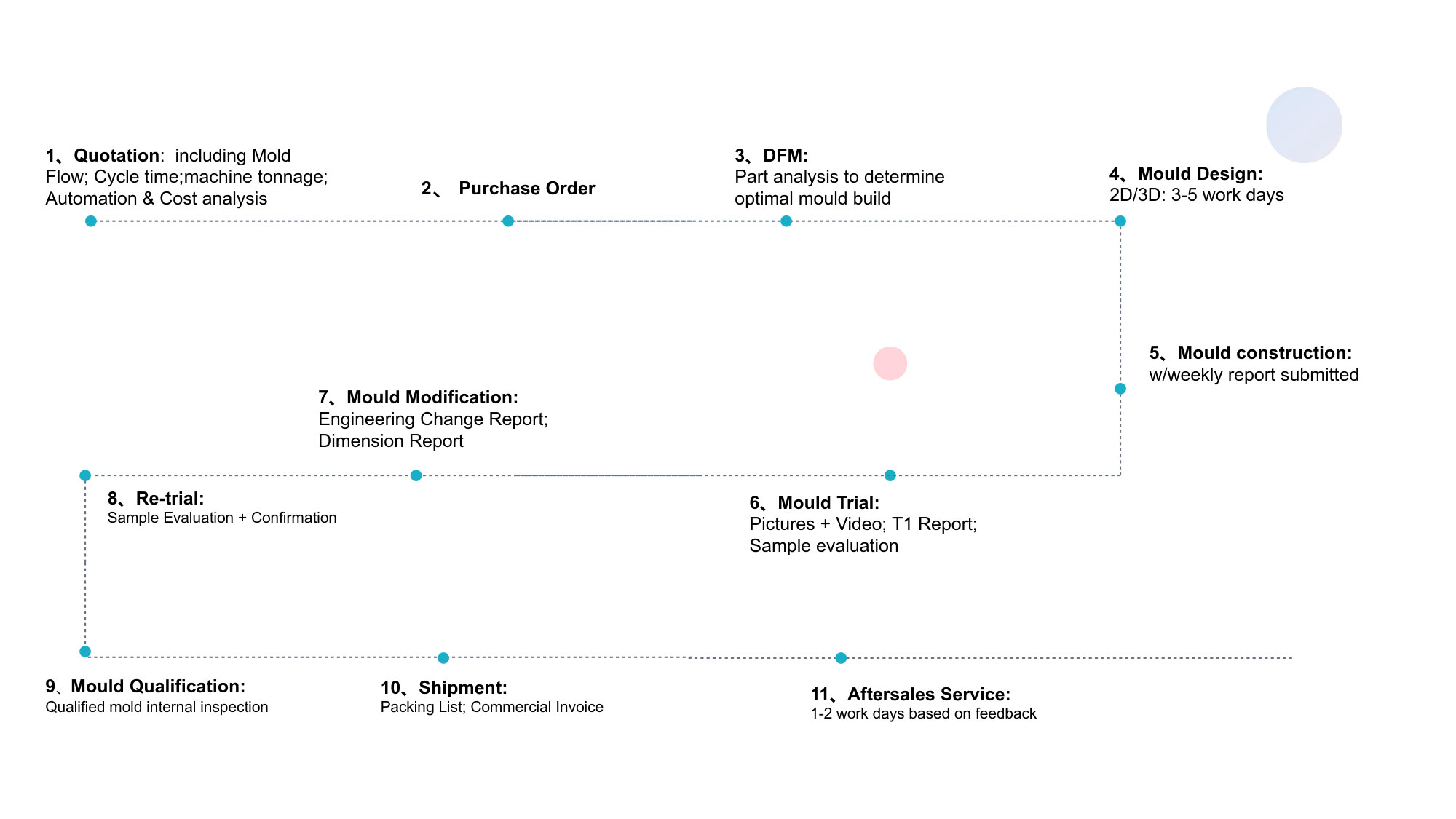
2.8 Mold Manufacturing Workflow
text
Week 1-2: Design Phase
├── Customer design review and DFM analysis
├── 3D modeling (SolidWorks / NX / Creo)
├── Mold flow simulation and optimization
├── Customer approval of gate locations, weld line positions, ejector mark areas
└── Steel ordering (certified materials with mill certificates)
Week 3-4: Rough Machining
├── 5-axis rough milling of mold base and cavity blocks
├── Heat treatment (vacuum hardening to specified HRC)
├── Tempering and stress relief
└── Surface grinding of reference planes
Week 5-7: Finish Machining
├── 5-axis finish milling (0.002mm accuracy)
├── Graphite electrode machining for EDM
├── EDM sparking for complex features (threads, narrow ribs)
├── Wire EDM for micro-vents and tight slots
└── Polishing to specified surface finish (Ra ≤0.05μm for high-gloss)
Week 8-9: Assembly and Fitment
├── Cavity and core fitting (0.005mm shut-off clearance)
├── Hot runner installation and leak testing
├── Cooling circuit pressure testing (200psi minimum)
├── Ejector system assembly and stroke verification
└── Mold base parallel and perpendicularity check
Week 10-11: Testing and Validation
├── Trial shot (T0) on injection press
├── Dimensional inspection of T0 samples (CMM report)
├── Mold flow correlation check
├── Customer sample submission (25–100 preforms)
├── T1, T2 modifications if required
└── Aging test (2,000 cycles wear documentation)
Week 12: Delivery
├── Full dimensional report with CPK ≥1.33
├── Spare parts kit (ejector pins, core inserts, wear plates)
├── Mold maintenance manual
├── Packing and shipment
Customer impact: A standard 410 neck preform mold is delivered in 35–45 days. If you need faster deployment, we offer expedited scheduling that compresses design and machining phases while preserving all inspection and validation steps.
III. Injection Molding Process Control
Why Your Quality Assurance Team Will Sleep Better
The most common customer anxieties about injection molding are:
Shrinkage and warpage: Will the preform dimensionally match the drawing?
Flash: Will I need manual deflashing operations?
Color inconsistency: Will each batch have the same tint and clarity?
Inconsistent blow results: Will each preform produce an identical bottle?
This section explains how we eliminate each anxiety.
3.1 Process Parameter Control
All production parameters are locked in the MES (Manufacturing Execution System)
Parameter Controlled Range Monitoring Method
Barrel temperatures (zones) Setpoint ±2°C Thermocouple feedback
Hot runner temperatures Setpoint ±1°C Individual zone control
Injection pressure Actual vs. target curve Real-time pressure transducer
Injection speed Profiled multi-stage Velocity feedback control
Holding pressure and time Profiled decay Closed-loop hydraulic servo
Cooling time Timer ±0.1 seconds PLC clock with backup
Mold temperature Setpoint ±1°C per zone Mold temperature controller
Back pressure Setpoint ±5 bar Pressure transducer
Screw rotation speed Setpoint ±5 rpm Encoder feedback
Cushion Automatic compensation Linear transducer
Critical: Only engineer-authorized personnel can modify parameters. All changes are logged with operator ID, timestamp, and reason code.
Customer impact: You receive process parameter sheets with your mold. When you run production on your own presses (or we run it for you), the process is documented and repeatable. No undocumented "tweaks" that cause quality drift.
3.2 Cooling Optimization
Cooling time accounts for approximately 28.78% of total cycle time for PET preforms and is the most significant factor affecting warpage.
Cooling Strategy Implementation Warpage Reduction Cycle Time Impact
Conformal cooling channels Curved channels following part contour Up to 4.75% -15% to -20%
Balanced cooling circuits Equal flow to all cavities 30% reduction in cavity-to-cavity variation Neutral
Uniform mold temperature distribution Zone-controlled TCUs Eliminates localized differential shrinkage -10% to -15%
Turbulent flow in core pins Reynolds number >4,000 Uniform wall temperature -5% to -10%
Industry-validated data: Using Taguchi method optimization, researchers achieved 4.75% warpage reduction and 2.05% weight reduction simultaneously through cooling parameter optimization.
Customer impact: Your preforms arrive at the blow molding station straight, round, and stress-free—no preform conditioning required before blowing.
3.3 Weight and Dimensional Consistency
Target and capability:
Metric Target Capability
Nominal weight (12g preform) 12.00g ±0.04g (±0.33%)
Critical neck dimensions (T, E, H) Per SPI 410 spec Tolerance half of specification
Concentricity Zero visible runout ≤0.02mm TIR
In-process verification:
Automated weight sampling every N cycles (frequency based on CPK)
Vision inspection of neck finish at machine exit
Polarized light check of gate area per shift
Thickness measurement via ultrasonic sensor (real-time feedback loop)
Customer impact: Your blow molding line runs at maximum speed because each preform is identical to the last. No preform sorting, no blow molder adjustments between batches.
3.4 Surface Finish and Optical Clarity
For cosmetic packaging, appearance quality sells the product.
Surface Quality Parameter Target Verification
Cavity surface finish (mold) Ra ≤0.05μm (mirror polish) Profilometer measurement
Preform surface defects No splay, haze, silver streaks, bubbles Visual inspection (standardized lighting)
Gate vestige <0.3mm projection Optical measurement
Clarity (finished bottle) Transmittance ≥91%, haze <1% Spectrophotometer
Color consistency ΔE <0.5 (per CIE Lab) Spectrophotometer per batch
Stress cracking None after 72-hour immersion in cosmetic formula Accelerated aging test
For premium cosmetic applications requiring the highest optical clarity:
Special polishing sequence (rough polish → fine polish → diamond paste)
Protective coatings on cavity surfaces to maintain polish over production life
Dedicated clean-room cell for molding transparent preforms
Customer impact: Your finished bottles display product perfectly through crystal-clear walls. There are no visible gate marks, flow lines, or stress birefringence patterns that cheapen brand perception.
3.5 Flash Control
Flash is a cost multiplier—it adds secondary deflashing operations, creates contamination risks, and damages brand aesthetics.
Flash Source Prevention Method Expected Flash
Parting line Precision-machined shut-offs (0.005mm clearance) <0.03mm
Ejector pin gaps Hardened pins with minimal clearance None to trace
Venting gaps Laser-cut vents (0.02-0.05mm depth) No flash from vents
Core-cavity mismatch Concentricity within 0.008mm None
Customer impact: Your preforms require no deflashing. They go directly from mold to packaging to blow molder, saving 0.5–1.5 seconds of labor cost per part and eliminating contamination risk from trimming dust.
3.6 Material Expertise: Beyond Standard PETG
Ansix Tech maintains deep process knowledge across a wide range of engineering thermoplastics. For cosmetic and personal care preforms, the following materials are in our portfolio:
Material Grades Processed Typical Applications
PET (virgin) Bottle-grade (IV 0.70–0.85) Standard beverage and cosmetic
PET (rPET) PCR, post-industrial, food-contact grade Sustainable packaging
PETG (glycol-modified) Eastman, SK Chemicals, domestic High-clarity, chemical-resistant cosmetics
PCTG Eastman Tritan™ Glass-like clarity, dishwasher-safe
PLA (polylactic acid) Bio-based grades Compostable packaging
PC (polycarbonate) Various High-impact applications
PP (polypropylene) Homopolymer, copolymer Lower-cost cosmetic containers
ABS General purpose Opaque personal care containers
Process capability summaries:
PETG processing requirements:
Pre-drying mandatory: moisture <0.04% (typically 4 hours at 65°C)
Melt temperature: 220–290°C (grade specific)
Mold temperature: 10–30°C (recommended 15°C)
Injection pressure: 30–130 MPa
Note: PETG offers a wider processing window than conventional PET
Recycled PET (rPET) considerations:
Capability up to 100% rPET in suitable applications
Requires integrated metal contaminant removal
Closed-loop color correction for batch-to-batch color variation
Customer impact: When you need to switch from PET to rPET or PETG to meet sustainability goals, we have established processes. No experimental trial-and-error—we deliver predictable quality from the first production run.
IV. End-to-End Service Architecture
Reducing Your Management Overhead
Working with multiple suppliers creates coordination costs: one vendor for mold design, another for mold manufacturing, a third for molding, a fourth for assembly, a fifth for packaging. Each handoff creates risk. This section explains how our integrated service model eliminates these inefficiencies.
4.1 DFM (Design for Manufacturability) Report — Early Risk Elimination
What we provide before you approve the project:
The DFM report answers three questions before they become problems:
Question DFM Analysis Provided
Can the part be molded? Wall thickness analysis; recommended draft angles; material shrinkage prediction
Will it be cosmetically acceptable? Gate location visualization; weld line position prediction; surface finish recommendations
Will it blow properly? Preform-to-bottle expansion simulation; thickness distribution prediction; blow ratio verification
Specific DFM deliverables for the 30-teeth, 12g, 410 neck preform:
Recommended gate location and type (balanced fill)
Ejector pin location map (marked on drawing)
Anticipated weld line location (avoiding critical sealing surfaces)
Cooling circuit layout (uniform temperature across 30 teeth)
Thread geometry verification (cap torque prediction)
Venting groove plan (no burn marks on transparent wall)
Customer impact: You review and approve the DFM before mold fabrication starts. No surprises. No "we didn't know that was a cosmetic surface." No charge for the DFM report.
4.2 Mold Fabrication and T-Sampling
Trial Stage Purpose Deliverable to Customer
T0 (first shot) Verify basic mold function Sample preforms (25–50 pcs) + dimensional report
T1 (first optimization) Address T0 findings Modified samples + change log
T2 (final validation) Verify all customer requirements 100–200 pcs for blow trial + full inspection report
T3 (production readiness) Confirmation of CPK ≥1.33 Production release document
What makes our T-sampling process different:
We don't charge extra for T0, T1, T2, T3 trials (included in mold price)
We provide a detailed improvement report after each trial
We can exchange mold inserts to test multiple variations without building a new mold
We blow-test sample preforms on our own blow molding equipment to validate bottle quality before shipping molds
Customer impact: You approve the final sample after we have already proven it works on blow molding equipment. No surprises when the mold arrives at your facility.
4.3 Low-Volume Pilot Run
Before full-scale production, we run a pilot batch of 1,000–5,000 preforms to validate:
Validation Point Sample Size Acceptance Criteria
Weight consistency All parts in pilot ±0.5% from nominal
Critical dimensions 30 pcs per cavity All within tolerance
Visual inspection 100% of pilot No splay, haze, contamination, flash
Blow trial 200 pcs 99.7% first-pass yield on blow molder
CPK calculation Pilot batch data ≥1.33 for critical features
Customer impact: You have statistical confidence before committing to full production volume. If we run 100,000 pieces, we know the 100,000th preform will match the first.
4.4 High-Volume Production
We run production on your schedule:
Order Volume Lead Time (post-sample approval) Production Method
10,000–50,000 5–7 working days Single shift; cold runner or small hot runner
50,000–250,000 7–10 working days Two shifts; hot runner
250,000–1,000,000 10–14 working days 24/7 operation; high-cavitation mold (72–144 cavities)
>1,000,000 (contract) Negotiated Dedicated cell; raw material inventory managed to your forecast
In-process quality during production:
First-article inspection at start of each production run
Patrol inspection every 2 hours
Statistical process control charting (weight, dimensions)
End-of-run dimensional audit
Retained samples from each lot (traceable to production date and cavity)
Customer impact: You receive production lots with full traceability. If a downstream quality issue appears, we can trace it to the specific cavity, production date, and material batch.
4.5 Assembly and Secondary Operations
For cosmetic packaging customers requiring finished tubes or bottles, we offer integrated secondary operations:
Operation Capability Accuracy
Blow molding (in-house) Up to finished bottle Full preform-to-bottle conversion
Trimming (neck and base) In-line deflashing ±0.2mm
Decorating (labeling, sleeving) Shrink sleeve, roll-fed, pressure-sensitive ±0.5mm registration
Assembly (pump, cap) Automated capping Torque ±0.1 N·m
Packaging Bulk pack, tray pack, retail-ready display Custom
Sterilization (medical grade) Ethylene oxide, gamma irradiation Certified
Customer impact: You manage one purchase order and one supplier relationship for finished, decorated, assembled packaging components ready for filling.
4.6 Warehousing and Just-in-Time Delivery
Service Description Benefit to You
Consignment inventory Preforms stored at our facility under your ownership Pay when you pull, not when we ship
Kanban replenishment Pull-based restocking based on your consumption No inventory carrying cost; no stockouts
Global shipping Air, sea, rail, or truck Choose speed vs. cost trade-off
Customs documentation Full export documentation package No delays at border
Regional warehousing Stock held in EU, US, Asia 48-hour delivery to local markets
Customer impact: Your packaging line never stops for lack of preforms. You don't tie up working capital in warehouse inventory.
4.7 Mold Maintenance and Spare Parts
Service Standard Premium
Spare parts included Ejector pins (set), core inserts (set), wear plates Full spare mold half
Mold maintenance Checklist and manual provided On-site technician visit
Repair response (standard) 5 working days 24 hours (expedited)
Tooling overhaul At 500,000 cycles (recommended) At 250,000 cycles (accelerated)
Cost of repair parts Standard pricing + 15% markup Cost + 10% for maintenance contract holders
Customer impact: You are never down waiting for mold repairs. Critical wear components are on your shelf before they fail.
4.8 Design for Manufacturing (DFM) Checklist for PETG Preforms
Before finalizing any cosmetic preform design, verify these DFM items:
text
□ Wall thickness uniform (±0.05mm target)
□ Draft angle ≥1° per side for all vertical walls (3° recommended for textured surfaces)
□ No sharp corners (minimum radius 0.5mm)
□ Gate location away from cosmetic surfaces
□ Weld line location avoids sealing surfaces and visible areas
□ Ejector pin marks located on non-cosmetic surfaces or bottom of preform
□ Neck finish threads complete, fully formed, and burr-free
□ Preform length compatible with blow molding machine stroke
□ Preform weight appropriate for target bottle capacity (see weight table in introduction)
□ Material specified (PET, PETG, rPET, PLA, etc.)
□ Color and clarity specifications documented (ΔE, haze, transmittance)
□ Packaging requirements defined (bulk, tray, reel)
□ Labeling and traceability requirements defined
V. Cost Optimization Strategies
How We Reduce Your Hard Costs Without Compromising Quality
Cost reduction is not about using cheaper materials or cutting corners. It is about engineering efficiency into every step of the manufacturing process. This section explains the specific mechanisms we use to lower your per-unit cost.
5.1 Material Cost Reduction
Strategy Mechanism Potential Saving
Weight optimization Process parameter tuning (cooling time, injection speed, holding pressure) 2.05% weight reduction documented in peer-reviewed research
Hot runner system Eliminates runner and sprue waste 15–30% raw material savings vs. cold runner
rPET substitution Replacing virgin PET with recycled content (up to 100%) 20–40% raw material cost reduction (market dependent)
Cavitation increase More parts per shot spreads fixed cycle cost Fixed overhead reduction per unit
Bulk resin purchasing Consolidated purchasing across multiple projects 5–10% below spot market
On-site regrind In-house recycling of start-up and scrap material Zero material cost for regrind-compatible applications
Customer impact: For a 10 million-unit annual volume of 12g preforms, a 2% weight reduction saves approximately 2,400kg of material annually. At market PETG prices, that is thousands of dollars directly to your bottom line.
5.2 Processing Efficiency
Efficiency Driver Implementation Cycle Time Impact
Conformal cooling Uniform temperature reduces required cooling -15% to -20%
High-speed injection Optimized fill rate without shear degradation -10% to -15%
Valve gate sequencing Eliminates hesitation-related cooling delays -5% to -10%
Automated part handling Conveyor vs. manual removal -2 to 3 seconds per cycle
Quick mold change systems 5-minute mold changes vs. 60-minute Maximum machine utilization
Industry benchmark: High-cavitation systems (144 cavities) achieve 4.5-second cycle times for 5.89g rPET preforms, enabling daily outputs of approximately 2.7 million preforms.
Customer impact: Faster cycles and higher cavitation mean your per-unit molding cost is minimized. We pass these efficiency savings to you.
5.3 Scrap Reduction
Scrap Source Baseline Industry Ansix Target Annual Saving (10M units, 1.5% scrap reduction)
Start-up scrap 1–2% of shift <0.5% $X,XXX avoided material cost
Rejects (visual) 1–3% <0.8% $X,XXX avoided material cost
Dimensional rejects 0.5–1% <0.3% $X,XXX avoided material cost
Blow molding rejects (preform-caused) 0.5–2% <0.2% $X,XXX avoided conversion cost
Key scrap reduction mechanisms:
MES parameter locking prevents operator-induced defects
In-line inspection removes non-conforming parts before packaging
Cavity-specific tracking identifies and shuts down defective cavities immediately
Automated process control compensates for material viscosity shifts
Customer impact: Every preform we ship is one you can use. No sorting, no returns, no wasted freight.
5.4 Supply Chain and Logistics Cost Reduction
Strategy Implementation Saving
Consolidation One supplier for mold + molding + assembly + decoration Eliminates multiple vendor management costs
Regional stocking Local inventory in your market Reduced freight and faster response
Bulk packaging Large gaylord boxes vs. small cartons Lower per-unit shipping cost
Container optimization Loading studies maximize container utilization 10–20% reduction in shipping cost per unit
Forecast-based production Level loading avoids air freight premiums 50–70% freight reduction vs. expedited
VI. Comparative Advantage Matrix
Why Choose Ansix Tech Over Competitors
Customer Pain Point Competitor Typical Response Ansix Tech Solution Customer Benefit
Mold arrives and doesn't fit machine "That's your machine, not our mold" DFM includes machine interface verification; we fit-check molds before shipment Zero installation surprises; 2-hour mold change
First production run has flash "Adjust your clamp pressure" 0.005mm shut-off clearance; self-compensating clamp force No deflashing; no trim waste
Preform dimensions drift during long run "Your operator changed a setting" MES-locked parameters; only engineer override Stable quality day and night
Blow molding yield varies batch to batch "Your blow molder is out of calibration" IV and AA tracking; blow tests on in-house equipment First-pass blow yield ≥99.5%
Mold repair takes 4–6 weeks "We're busy, we'll get to it" In-house repair shop; 24-hour emergency service Downtime measured in days, not weeks
Sample approval takes 8 weeks "Our machining queue is full" Dedicated sample production cell; T0 in 10–15 days Time-to-market accelerated by 30–40%
Pricing unclear; hidden costs Quote for mold only; no lifetime cost estimate All-inclusive quote: mold + tooling validation + spares + training No financial surprises
No support after shipment "Good luck with your production" 24/7 technical support line; on-site commissioning available Continuous production support
VII. Project Initiation Framework
How to Start Working with Ansix Tech on Your 30-Teeth, 12-Gram, 410 Neck PETG Preform Project
Step 1: Initial Inquiry (Days 0–2)
Provide: 3D CAD model (STEP, IGES, or native), 2D drawing with tolerances, material specification, annual volume estimate, target pricing.
→ We respond with preliminary DFM comments and budgetary quotation within 48 hours.
Step 2: DFM Review (Days 3–7)
We prepare a detailed DFM report including: gate location recommendations, weld line prediction, ejector pin location map, cooling layout, and wall thickness optimization.
→ We schedule a 60-minute review call to walk through the DFM and answer questions.
Step 3: Mold Design and Approval (Days 8–14)
We complete 3D mold design, hot runner selection, and cooling circuit layout.
→ You approve design drawings before machining starts.
Step 4: Mold Fabrication (Days 15–55)
Machining, EDM, assembly, and T0 sampling.
→ Weekly progress updates with photos.
Step 5: Validation and Approval (Days 56–65)
T0, T1, T2 sampling, dimensional inspection, blow trial, CPK calculation.
→ You approve final samples.
Step 6: Production and Delivery (Day 66 onward)
Pilot run, high-volume production, packaging, and shipping.
→ Ongoing SPC data provided per shipment.
Conclusion
At Ansix Tech, we translate technical expertise in mold engineering, injection molding, and material science into tangible customer outcomes: lower per-unit cost through weight optimization and energy efficiency; higher blow molding yields through dimensional consistency and stress-free preforms; reduced risk through CPK ≥1.33 on all critical features; and faster time-to-market through integrated DFM, mold fabrication, and production services.
The 30-teeth, 12-gram, 410 neck PETG preform is not a commodity—it is a precision component that determines the quality, appearance, and functionality of your finished cosmetic and personal care packaging. With 28+ years of experience, 260 injection molding machines across four facilities, and a comprehensive quality system, Ansix Tech is equipped to be your single-source partner.
The numbers that matter:
28+ years of injection molding and mold engineering experience
260 injection molding machines (30 to 2,800 tons)
4 manufacturing facilities (China and Vietnam)
Up to 144 cavities in a single mold
4.5–6 second cycle times for lightweight preforms
CPK ≥1.33 on all critical dimensions
1,000,000+ guaranteed mold life
35–45 day standard mold lead time
Ready to move forward?
Contact Ansix Tech with your 3D model and annual volume estimate. We will return a DFM report and a transparent, all-inclusive quotation within 48 hours.
Ansix Tech Co Ltd
If you have any plans related to 30 teeth, 12 grams, 410 standard mouth, PET bottle preform, PETG material, cosmetic and personal care bottle preform tube , you can contact us at any time. We will turn your ideas into reality, let you realize your dreams, and obtain large orders from the market. Our contact information is info@ansixtech.com. Or contact our CTO, mail: stephen@ansixtech.com
#www.ansixtech.com #ansixtech.com #30 teeth, 12 grams, 410 standard mouth, PET bottle preform, PETG material, cosmetic bottle #30 teeth, 12 grams, 410 standard mouth, PET bottle preform, PETG material, cosmetic bottle #30 teeth, 12 grams, 410 standard mouth, PET bottle preform, PETG material, cosmetic bottle injection molding companies #30 teeth, 12 grams, 410 standard mouth, PET bottle preform, PETG material, cosmetic bottle Canopy Mold injection mold companies #Ansix #Ansix moulds #Ansix china #Ansix tech china #Ansix tech company #Ansix facotry #30 teeth, 12 grams, 410 standard mouth, PET bottle preform, PETG material, cosmetic bottle injection molding #30 teeth, 12 grams, 410 standard mouth, PET bottle preform, PETG material, cosmetic bottle injection tools #30 teeth, 12 grams, 410 standard mouth, PET bottle preform, PETG material, cosmetic bottle injection moulds #30 teeth, 12 grams, 410 standard mouth, PET bottle preform, PETG material, cosmetic bottle plastic mould #30 teeth, 12 grams, 410 standard mouth, PET bottle preform, PETG material, cosmetic bottle plastic tools #Ansix Tech #Ansix molds #Ansix injection molding #Ansix mold factory #injection molding 30 teeth, 12 grams, 410 standard mouth, PET bottle preform, PETG material, cosmetic bottle #Ansix mold factory #30 teeth, 12 grams, 410 standard mouth, PET bottle preform, PETG material, cosmetic bottle china #30 teeth, 12 grams, 410 standard mouth, PET bottle preform, PETG material, cosmetic bottle molds #injection factory #30 teeth, 12 grams, 410 standard mouth, PET bottle preform, PETG material, cosmetic bottle injection molding #30 teeth, 12 grams, 410 standard mouth, PET bottle preform, PETG material, cosmetic bottle injection molding factory #injection molding company #30 teeth, 12 grams, 410 standard mouth, PET bottle preform, PETG material, cosmetic bottle injection mold companies #30 teeth, 12 grams, 410 standard mouth, PET bottle preform, PETG material, cosmetic bottle#30 teeth, 12 grams, 410 standard mouth, PET bottle preform, PETG material, cosmetic bottle mold limited #Ansix mold china #Ansix companies #Ansix company China #30 teeth, 12 grams, 410 standard mouth, PET bottle preform, PETG material, cosmetic bottle facotry #Ansix Tech #Ansix Tech mould #30 teeth, 12 grams, 410 standard mouth, PET bottle preform, PETG material, cosmetic bottle injection moulding #injection moulding company #Ansix 30 teeth, 12 grams, 410 standard mouth, PET bottle preform, PETG material, cosmetic bottle parts injection mold companies #medical injection molding companieschina #30 teeth, 12 grams, 410 standard mouth, PET bottle preform, PETG material, cosmetic bottle china factory #Ansix moulding companies #Ansix molding company #30 teeth, 12 grams, 410 standard mouth, PET bottle preform, PETG material, cosmetic bottle injection moulding facotry #Ansix Tech mold #30 teeth, 12 grams, 410 standard mouth, PET bottle preform, PETG material, cosmetic bottle mould #30 teeth, 12 grams, 410 standard mouth, PET bottle preform, PETG material, cosmetic bottle plastic injection molding #ansix plastic mold #Mold manufacturing #30 teeth, 12 grams, 410 standard mouth, PET bottle preform, PETG material, cosmetic bottle parts manufacturing #30 teeth, 12 grams, 410 standard mouth, PET bottle preform, PETG material, cosmetic bottle plastic parts factory #30 teeth, 12 grams, 410 standard mouth, PET bottle preform, PETG material, cosmetic bottle injection parts mold #30 teeth, 12 grams, 410 standard mouth, PET bottle preform, PETG material, cosmetic bottle PRECISION MANUFACTURING #30 teeth, 12 grams, 410 standard mouth, PET bottle preform, PETG material, cosmetic bottle #China mold #30 teeth, 12 grams, 410 standard mouth, PET bottle preform, PETG material, cosmetic bottle injection moulding china #30 teeth, 12 grams, 410 standard mouth, PET bottle preform, PETG material, cosmetic bottle mould china #china precision mold #mold in china #30 teeth, 12 grams, 410 standard mouth, PET bottle preform, PETG material, cosmetic bottle mold china #Precision molds #High-precision molds #30 teeth, 12 grams, 410 standard mouth, PET bottle preform, PETG material, cosmetic bottle #Injection molds #30 teeth, 12 grams, 410 standard mouth, PET bottle preform, PETG material, cosmetic bottle Factory #30 teeth, 12 grams, 410 standard mouth, PET bottle preform, PETG material, cosmetic bottle Company #Super Large Injection Mold Factory #Large Tonnage Injection Molding Factory #30 teeth, 12 grams, 410 standard mouth, PET bottle preform, PETG material, cosmetic bottle Company #30 teeth, 12 grams, 410 standard mouth, PET bottle preform, PETG material, cosmetic bottle Factory #2800T Injection Molding Factory #3000 Ton Injection Molding #4500 Ton Injection Molding Factory #Large Mold Injection Molding #Large Plastic Mold Injection Molding Factory #Large Injection Mold Manufacturer #Plastic Mold Factory #Injection Mold #Plastic Mold