



68mm diameter 25g wide-mouth PET plastic tube preform for skincare bottle blow molding special threaded nozzle bottle preform
FEATURES
The Foundation of Hard-Power Capabilities (Building Customer Confidence Through Equipment Infrastructure)
Your confidence in a manufacturing partner begins with the tools they use. Ansix Tech operates four production bases across China and Vietnam, equipped with 260 injection molding machines ranging from 30 tons to 2,800 tons in clamping force, featuring leading brands including Fanuc, Sumitomo, Toshiba, Nissei, Engel, and Arburg .
What This Means for You
Technical Asset What We Say What You Get
Five-axis high-speed machining centers We machine complex curved surfaces with ±0.002mm precision Seamless, burr-free parting lines on your preform threads—no secondary finishing, no sharp edges that compromise seal integrity
Slow-wire EDM (AgieCharmilles) We achieve 0.002mm dimensional accuracy for fine hole erosion and narrow slots Precision cavity detail that eliminates flash and ensures consistent wall thickness across every single preform
Swiss GF Machining 5-axis (±0.003mm accuracy) Complex cavity machining efficiency increased by 50% Faster mold delivery without sacrificing precision—your production timeline accelerated
In-process laser calibration Real-time verification during machining Zero deviation accumulation, meaning the 1st preform matches the 1,000,000th preform
High-speed machining (HSM) on NAK80 steel Surface roughness Ra ≤ 0.1μm, extending mold lifespan by 30% Longer tool life means fewer mold rebuilds, less downtime, lower long-term ownership cost
-
Mold Description
Product Materials:
PET PETG
Mold Material:
S136ESR
Number of Cavities:
8
Glue Feeding Method:
Hot runner
Cooling Method:
Water cooling
Molding Cycle
12.5s
- The mold manufacturing process and product material selection
The Foundation of Hard-Power Capabilities (Building Customer Confidence Through Equipment Infrastructure)
Your confidence in a manufacturing partner begins with the tools they use. Ansix Tech operates four production bases across China and Vietnam, equipped with 260 injection molding machines ranging from 30 tons to 2,800 tons in clamping force, featuring leading brands including Fanuc, Sumitomo, Toshiba, Nissei, Engel, and Arburg .
What This Means for You
Technical Asset What We Say What You Get
Five-axis high-speed machining centers We machine complex curved surfaces with ±0.002mm precision Seamless, burr-free parting lines on your preform threads—no secondary finishing, no sharp edges that compromise seal integrity
Slow-wire EDM (AgieCharmilles) We achieve 0.002mm dimensional accuracy for fine hole erosion and narrow slots Precision cavity detail that eliminates flash and ensures consistent wall thickness across every single preform
Swiss GF Machining 5-axis (±0.003mm accuracy) Complex cavity machining efficiency increased by 50% Faster mold delivery without sacrificing precision—your production timeline accelerated
In-process laser calibration Real-time verification during machining Zero deviation accumulation, meaning the 1st preform matches the 1,000,000th preform
High-speed machining (HSM) on NAK80 steel Surface roughness Ra ≤ 0.1μm, extending mold lifespan by 30% Longer tool life means fewer mold rebuilds, less downtime, lower long-term ownership cost
-
Injection Molding Machine Capabilities
Machine Brand Clamping Force Range Core Value Delivered
Fanuc / Sumitomo / Toshiba / Nissei 30–2,800 tons All-electric servo drives deliver ±0.1% repeatability stability—every molding cycle produces identical preforms
Engel / Arburg Specialized for LSR and two-shot molding Expertise for specialized requirements, including multi-material preform configurations
Haitian High-volume domestic platforms Cost-effective mass production capacity backed by global-standard quality
The outcome: Your 68mm diameter 25g wide-mouth preform will be produced on equipment specifically calibrated for PET material characteristics—narrow melting window (290–315℃), precise crystallization control, and rapid cooling transition to transparent amorphous state .
Metrology and Inspection Equipment
Device Measurement Capability Your Benefit
CMM (Coordinate Measuring Machine) Full dimensional reporting against CAD model Every mold shipped with a comprehensive dimensional report; critical dimensions validated to CPK ≥ 1.33
Optical vision inspection system Inline measurement of key features Defects—short shots, flash, gate blush—detected before parts reach downstream operations
Vision-based SPC system Real-time quality data integrated with MES dashboard Data-driven stability across entire production runs
We deliver full dimensional conformity reports with each mold shipment. No guesswork. No assumptions. Just validated precision.
Section 2: Mold Manufacturing Core Competitiveness (Speaking with Concrete Metrics)
Your mold is the heart of your production line. It determines your throughput, your quality consistency, and your operating costs. At Ansix Tech, we build molds that last, molds that perform, and molds that deliver measurable ROI.
Mold Life Expectancy (Your ROI Protector)
Mold Component Steel Grade Hardness (HRC) Guaranteed Life What This Means for Your Business
Core and cavity ASSAB S136 (Swedish imported) 48–52 HRC 500,000+ cycles for glass-filled materials; 1,000,000+ cycles for standard plastics One tooling investment supports years of production—amortize your mold cost across millions of parts
Neck ring DIN 1.2083 (German) 45 HRC Superior thread wear resistance Thread precision maintained over millions of closures, ensuring consistent cap fit and seal
Hot manifold DIN 1.2344 (Thyssen Krupp) — Optimized thermal stability Uniform melt distribution across all cavities
Mold base P20 30–35 HRC Structural integrity for life Your mold remains dimensionally stable through millions of clamping cycles
Every mold is supplied with steel certification reports and heat treatment curves. You know exactly what you’re getting, and you can trace material provenance to the mill.
Achievable Dimensional Tolerances
Feature Type Standard Tolerance Precision Tolerance (Upon Request)
Structural components (mold plate alignment) ±0.05mm ±0.01mm
Critical cavity/core features ±0.005–0.01mm ±0.002mm
Thread profile (neck finish) ISO threaded finish standard Certified gauge fit capability
Gate location and ejection pin marks Defined and agreed pre-production Acceptable zones documented in DFM
Mold Type Expertise
Mold Type Applicability Efficiency Gain Your Benefit
Hot runner system (standard for PET preforms) 8–144 cavities typical Insulated between mold and platen with high-pressure heat shield Reduced scrap from cold runners, higher material utilization, faster cycles
Conformal cooling channels (additive manufactured inserts) Optimized for 68mm wide-mouth geometry 30% faster cooling, 22% cycle time reduction More preforms per hour = lower cost per part
Multi-cavity configurations Scalable from low-volume (8 cavities) to high-volume (96+ cavities) Production volume flexibility Start small, scale as demand grows—tooling investment proportional to volume
Heat shield technology is essential for PET preform molding. We install 12mm heat insulation plates between the mold and machine platen that withstand high pressure, ensuring thermal stability throughout the injection cycle .
Gate and Runner Optimization Through Mold Flow Analysis
Before cutting any steel, we simulate your entire injection process using Moldex3D—the industry’s leading CAE mold flow analysis platform .
What Moldex3D analysis delivers for your 68mm diameter preform:
Simulation Output Risk Addressed Your Value
Weld line prediction Pre-identified locations where melt fronts meet Gates repositioned to shift weld lines away from cosmetic surfaces or structural stress zones
Air trap visualization Gas entrapment during filling Venting paths added before machining—eliminating burn marks and short shots
Shear stress mapping Material degradation risk Temperature and speed profiles optimized to prevent IV (intrinsic viscosity) drop in PET
Cooling uniformity analysis Differential cooling leading to warpage Cooling circuit design validated before mold build—no “first shot surprises”
Gate location and quantity optimization Fill imbalance across multi-cavity molds Balanced cavity filling ensures every preform is identical regardless of cavity position
The result: A mold that fills properly from the first shot. No trial-and-error. No costly rework.
Mold Delivery Standards
Mold Complexity Standard Lead Time Expedited Option Guarantee
Simple preform mold (≤8 cavities) 10–15 days 7–10 days Validation steps never skipped—expedited means prioritized, not compromised
Medium complexity (16–48 cavities) 25–35 days 20–25 days Full mold flow analysis and T0 sample included
High-cavity production (64–144 cavities) 35–50 days 30–40 days Phased delivery available for staged ramp-up
Section 3: Injection Molding Process Control (Eliminating Your Quality Anxiety)
The most perfectly machined mold produces poor parts if the injection process isn‘t controlled. Every customer fears variation: shrinkage, flash, dimensional drift, and batch-to-batch color differences. We’ve engineered those risks out of our system.
Process Standardization and MES Integration
Every Ansix Tech injection molding machine is connected to a central Manufacturing Execution System (MES). All critical process parameters—temperature profiles, injection pressure, screw speed, holding pressure profile, cooling time—are locked within the MES. Only authorized process engineers can adjust settings, and all changes are logged with timestamps and approval records .
What this means for you:
No unauthorized parameter changes — Your approved process stays approved
Full traceability — Every batch can be traced to specific machine, date, shift, and material lot
First-article and last-article comparison — Every production run begins and ends with dimensional verification
Dimensional Stability Control
Control Method Technical Implementation Your Quality Assurance
Zone temperature control Mold temperature controllers (water or oil) maintaining core/cavity temperature differential within ±2℃ Reduced warpage—preform neck and body remain concentric, ensuring proper blow molding orientation
Ultrasonic wall thickness monitoring Real-time feedback during injection Actual wall thickness measured continuously; automatic adjustments to hold pressure when deviation is detected
In-mold temperature/pressure sensors Closed-loop control integrated into mold base Process corrections happen automatically, mid-cycle—no operator intervention required
Conformal cooling channels 3D-printed cooling circuits optimized for PET‘s narrow crystallization window Faster cycle times (target 12–18 seconds for 25g preform) without compromising transparency
Track record: For similar container preform projects, we have demonstrated week-long continuous production across three separate batches with critical dimensional variation ≤ 0.02mm.
Appearance Quality Grades
Grade Specifications Application
Optical clarity (PET standard) No bubbles, no flow lines, no splay marks Premium skincare bottles requiring crystal-clear transparency
High-gloss finish Surface roughness Ra ≤ 0.2μm Direct cosmetic contact surfaces
Matte/textured finish Custom SPI-grade finishes Branded aesthetic requirements
Color consistency Delta E < 0.5 across batch Multi-cavity molds deliver identical color cavity-to-cavity
Advanced Material Capabilities (Beyond PET)
While your 68mm wide-mouth preform calls for PET material, we bring deep expertise across the full plastics spectrum—giving you future flexibility if product requirements evolve.
Material Category Specific Grades Performance Characteristics
Standard engineering plastics PC (Lexan), ABS, PC/ABS blends Impact resistance, dimensional stability
High-temperature thermoplastics PEEK, PEI (Ultem), PPS Thermal stability up to 260℃ continuous use
Glass-filled compounds PPS+40%GF, PA6+GF30 High stiffness, creep resistance for threaded closures
Flame-retardant grades UL94 V-0 rated materials Safety compliance for regulated markets
Specialty fluoropolymers PTFE, PFA, PVDF Chemical resistance for aggressive formulations
Liquid silicone rubber (LSR) Medical-grade LSR Soft-touch seals, gaskets, and overmolded components
Moisture Control for PET (Critical for Quality)
PET is hygroscopic. Improper drying means hydrolytic degradation—resulting in splay marks, reduced IV (intrinsic viscosity), and brittle final bottles. Our control targets:
Parameter Specification Measurement Frequency
Resin moisture content < 50 ppm (before processing) Continuous monitoring during drying
IV drift (intrinsic viscosity) Within ±0.02 dL/g of baseline Every shift—material lot validation
Cavity-to-cavity weight variation ±0.2–0.5% of target Automated sampling per production hour
Recycled PET content control ≤25% (food/beauty grade) Material certification and batch tracking
Optimized Process Parameters for 68mm Diameter 25g PET Preform
Based on industry best practices and our in-house validation data, the optimized parameter window for your preform is:
Parameter Target Setting Why This Matters
Melt temperature 270–295℃ (standard PET); 290–315℃ (GF-reinforced) PET’s narrow processing window demands tight control—lower leads to incomplete melting; higher causes thermal degradation
Mold temperature 65–75℃ (core/cavity differential < 2℃) Balanced cooling prevents warpage; ensures amorphous (transparent) preform structure
Holding pressure 110–130 MPa Minimizes shrinkage; maintains dimensional accuracy of threaded neck
Cooling time 12–18 seconds (based on 25g shot weight) Uniform cooling before ejection prevents post-mold deformation
Injection speed Progressive filling profile (slow start → fast fill → slow pack) Prevents jetting and splay; ensures even wall thickness distribution
The bottom line: You receive parts that are dimensionally consistent, optically clear, and processed on validated parameters—no “tweaking” required when you scale from trial to production.
Section 4: End-to-End Service Delivery (Reducing Your Management Overhead)
The most overlooked cost in manufacturing is not the price of the mold or the part—it‘s the cost of managing the supplier relationship. Every email, every phone call, every sample evaluation, every delay communication consumes your team’s time and attention.
Ansix Tech is designed to be a low-friction partner.
Early Engagement: DFM Report Before You Commit
Before we accept a single dollar of your tooling investment, we deliver a comprehensive Design for Manufacturing (DFM) report that includes:
DFM Section What We Analyze The Risk We Eliminate
Draft angle recommendations Minimum draft required for ejection based on your surface finish Parts stuck in mold = production stoppage = missed delivery
Wall thickness optimization Uniformity analysis; stress concentration identification Thin spots cause blow-out during blowing; thick spots extend cycle time
Gate location agreement Acceptable gate vestige location and appearance No surprise marks on critical cosmetic surfaces
Ejection pin placement map Pin mark locations, sizes, and depths documented Avoid interference with threads or sealing surfaces
Shrinkage accommodation Material-specific shrinkage factored into cavity dimensions Final parts match your CAD model—no “mold works but parts are undersized” surprises
You receive this report pre-contract. We’re transparent about what‘s possible before you commit to anything.
Sampling and Validation Protocol (T0 through T3)
Milestone Deliverable What We Provide
T0 (First off-tool samples) First molded parts from completed mold 50–100 samples; full dimensional inspection report; defect photography with root cause analysis
T1 (First optimization run) Mold adjustments applied based on T0 findings Revised samples; improvement report tracking changes from T0; updated CPK projections
T2 (Pre-production validation) Process stabilization run 200–500 samples; statistical process control data; CPK ≥ 1.33 demonstration
T3 (Production release) Approval for mass production Comprehensive final report: all dimensional data, material certifications, process parameters, recommended maintenance schedule
No surprises. No hidden rounds of unpaid rework. Every validation step is documented and shared.
Quick-Change Insert Capability
We design molds with interchangeable inserts, allowing you to validate different design variations without building an entirely new mold.
Your benefit: Explore multiple gate configurations, thread profiles, or wall thickness options for the cost of steel changes—not a full mold rebuild.
Small-Batch Pilot Production
Before committing to full-scale mass production, we offer pilot runs of 100–500 parts manufactured under production-intent conditions.
What this validates:
Actual production yield (not just engineering sample yield)
Real cycle times (not theoretical projections)
Process stability across a representative batch
Packaging and logistics requirements
Only after pilot validation do we proceed to full rate production.
Maintenance and Spare Parts Program
Service Commitment
Spare parts package Wear parts (ejector pins, core pins, gate inserts) supplied with mold at time of delivery
Scheduled maintenance Comprehensive mold cleaning and inspection every 200,000 cycles
24-hour emergency repair In-house electrode machining center and EDM shop—repairs typically completed within 24 hours; mold back in production same day
Lifetime repair service Labor charged at cost; materials at cost; never a profit center on repairs
Mold structure warranty 3 years on structural integrity (excluding normal wear parts)
Section 5: Differentiators and Direct Commitments (Addressing Industry Pain Points)
Rather than listing our strengths, let‘s address the complaints you’ve likely heard—or experienced—from other suppliers.
Common Industry Complaint Your Experience with Ansix Tech
“We constantly stop production to repair flash on the mold.” We machine parting lines to ±0.005mm tolerance and use self-locking clamp force compensation. Flash is held to ≤0.03mm—minimal to none, eliminating manual deflashing labor.
“Parts from the same mold vary in size between batches.” All machines are MES-integrated with parameter lockdown. Ultrasonic wall thickness sensors provide real-time feedback; closed-loop control adjusts holding pressure automatically.
“Every time we need mold repair, the lead time is weeks.” Our in-house electrode machining center and EDM shop mean most repairs stay within our facility. Standard welding/core pin replacement completes within 24 hours.
“We received the mold, but it didn‘t run as expected on our floor.” Before shipping, each mold runs a 2,000-cycle accelerated aging test on a press identical to your specified machine type. You receive a wear report documenting performance. We also include a recommended machine settings card tuned for your exact machine brand and tonnage.
“Our transparent preforms have haze or bubbles.” We control the root causes: PET dried to <50 ppm moisture; optimized screw L/D ratio (24:1–25:1) with barrier screw design; AA levels maintained ≤5 ppm, critical for food/beauty-grade packaging.
“The supplier disappeared after we paid for the mold.” We deliver a complete mold history file: CAD data (native and neutral formats), steel certifications, heat treatment curves, process parameter logs, spare parts list, and recommended maintenance interval chart. We’re here for the life of the mold.
Section 6: Intelligent Manufacturing Integration and Industry 4.0 (Efficiency at Scale)
Ansix Tech has implemented a comprehensive Industry 4.0 intelligent manufacturing ecosystem across all four production facilities . This isn‘t marketing language—it’s operational reality that directly reduces your cost per part.
Digital Twin Validation
Before physical mold manufacturing begins, we create a complete digital twin of your mold and injection process:
Digital Simulation Purpose Your Time-to-Market Benefit
Mold filling simulation (Moldex3D) Optimize gate location, runner balance, vent placement First physical shots come out correct—no multiple trial rounds
Cooling circuit analysis Validate conformal cooling design, predict cycle time Confident cycle time estimates for your business case
Warpage prediction Anticipate post-mold deformation based on material and cooling Mold modifications made digitally, not physically—saving weeks of rework
Shrinkage compensation Scale cavity geometry to produce parts that match your CAD No mismatches between your design and physical parts
The result: What used to require 3–5 physical mold revisions now typically requires 0–1. Your mold is right the first time.
Factory-Wide Automation
Automation Layer Implementation
Parts removal Robotic pick-and-place for consistent handling—no damage from dropping or operator inconsistency
Conveyor integration Gentle part handling to minimize surface defects; automated preform sampling for quality inspection
Material handling Centralized drying and conveying; moisture monitoring <50 ppm continuously
Packaging integration Automated counting and bagging at machine exit
Real-time OEE tracking MES dashboard showing overall equipment effectiveness, scrap rates, energy consumption per part
Cycle Time Optimization—Direct Cost Reduction
For your 25g 68mm preform, our target cycle time range is 12–18 seconds, depending on cavity count and cooling design.
Your direct financial benefit:
Scenario Standard Cooling Conformal Cooling (Our Standard) Your Savings
Cycle time per part 16–20 seconds 12–16 seconds 20–25% faster
Parts per hour (48 cavities) ~8,640–10,800 ~10,800–14,400 +2,160–3,600 parts per machine hour
Annual production (8,000 hours) ~69–86 million preforms ~86–115 million preforms +17–29 million preforms/year
These numbers represent tens of thousands of dollars in annual savings from a single press—achieved through mold design optimization, not machine upgrades.
Section 7: Customer Value Transformation (Turning Specifications into Savings)
At the heart of every technical decision we make is one question: What does this mean for your bottom line?
How We Systematically Reduce Your Hard Costs
Cost Category Traditional Approach Cost Ansix Tech Optimized Approach Your Savings
Material cost Standard PET resin at market price Bulk procurement across multiple customers; rPET blend options (up to 25%); design optimizing wall thickness to minimum functional 8–15% reduction on material spend
Cycle time cost Industry average 18–20 seconds Optimized conformal cooling + hot runner balance → 12–15 seconds typical 20–30% more parts per hour = lower cost per part
Mold amortization cost Mold lasts 300,000–500,000 cycles before significant maintenance S136 steel + vacuum heat treatment + proper cooling → 1,000,000+ cycles before major rebuild Mold cost spread across more parts = 40–60% lower depreciation per part
Quality rework cost 2–5% scrap typical in blow molding from inconsistent preforms CPK ≥ 1.33 dimensional stability; cavity-to-cavity weight variation ≤0.5% Scrap below 1% possible; blow molding success rate >99.5%
Labor cost Manual deflashing; manual quality sampling Flash ≤0.03mm eliminates manual finishing; automated vision inspection Headcount reduction of 2–4 operators per shift
Energy cost Standard machine efficiency All-electric servo drives + optimized cooling → 20–30% lower kWh per part Reduced utility bills without production sacrifice
Secondary operations Post-mold trimming or gate removal required Hot runner gate design optimized for clean break; gate location on non-cosmetic surface Eliminate entire secondary operation step
Real Case Example: Desktop Vacuum Cleaner Filter Mold
In a recent project, Ansix Tech achieved over 30% total cost reduction for the customer through:
Strategy Action Result
Material cost reduction Selection of high-performance, lower-cost PP grade Immediate material spend reduction
Process efficiency Cycle time reduction through optimized cooling and gate design 22% cycle time reduction
Another project eliminated paint and coating entirely through conformal cooling and robotic parts removal, reducing consumable costs and cycle time simultaneously while maintaining or exceeding the painted product‘s aesthetic standard .
Transparent Total Cost of Ownership (TCO) Analysis
For every project, we provide a projected TCO comparison:
TCO Component Formula What We Promise
Mold investment One-time tooling cost Competitive upfront pricing with clear AMORTIZATION period estimate
Per-part variable cost Material + Machine time + Labor + Energy + Quality Guaranteed per-part price stability for 12 months
Maintenance cost Scheduled + Emergency Scheduled maintenance at fixed rate; emergency repair at cost
End-of-life cost Mold refurbishment or replacement Refurbishment quote provided at 800,000-cycle mark
The result: You’re not buying a mold and hoping it works. You‘re buying a predictable cost per part for years to come.
Section 8: Material Science Foundation for 68mm Diameter 25g PET Preform
PET Resin Characteristics and Selection Criteria
PET (polyethylene terephthalate) is the material of choice for your skincare tube preform due to its excellent clarity, barrier properties, and mechanical strength.
Property Specification Impact on Your Product
Intrinsic Viscosity (IV) 0.72–0.84 dL/g Higher IV = stronger bottle; lower IV = easier flow. For skincare tubes requiring durability, we target IV 0.80–0.84
Melting point ~250–260°C Determines processing temperature window
Glass transition temperature (Tg) ~75–80°C Critical for reheating before blow molding; preform must be reheated just above Tg (~75°C) to enable orientation
Crystallization rate Slow Requires rapid cooling below Tg to maintain transparency; slow cooling allows crystals to form, creating haze
Moisture absorption 0.4% at saturation Must be dried to <50 ppm before processing to prevent hydrolytic degradation (IV drop)
Raw Material Grades Typically Specified
Grade Manufacturer Characteristics Application
PET CB-12 Far Eastern Group High IV (~0.84), excellent clarity Premium skincare and cosmetic bottles
PET 801 Sinopec Medium IV (~0.80), good processability Standard beauty and personal care packaging
PET CB-608S Far Eastern Group Balanced IV and flow Wide-mouth jars requiring thicker walls
rPET blends Various Up to 25% post-consumer recycled content Sustainability-focused brands
Material Processing Requirements
Requirement Specification Consequence of Non-Compliance
Drying temperature 160–180°C Insufficient drying → splay, bubbles, reduced IV
Drying time 4–6 hours Incomplete drying → hydrolytic degradation
Dew point -40°C or lower Moisture reabsorption during processing → bottle brittleness
Screw L/D ratio 24:1 to 25:1 with barrier screw design Poor mixing or excessive shear → inconsistent melt quality
AA (acetaldehyde) level ≤5 ppm for food/beauty grade Higher AA → off-taste/odor for product-sensitive applications
Crystallization Control for Transparency
PET has a narrow processing window: if the melt cools too slowly before dropping below Tg, crystalline regions form, creating haze and opacity. Our mold cooling systems are designed to achieve rapid, uniform temperature reduction—typically reducing preform temperature from melt state (~280°C) to ejection temperature (<50°C) in the target cycle time.
The value to you: Crystal-clear preforms that blow into equally transparent bottles—no haze, no yellowing, no visible weld lines on the final container.
Section 9: Challenges in Manufacturing 68mm Diameter 25g Preform—And Our Solutions
Manufacturing Challenge 1: Wide-Mouth Neck Finish Dimensional Stability
A 68mm diameter neck is significantly larger than standard beverage preforms (typically 28–38mm). Larger neck diameter means:
Greater shrinkage variation
Higher risk of thread pitch distortion
More challenging cooling uniformity around thick neck geometry
Ansix Solution:
Strategy Implementation Your Benefit
Independent neck cooling circuits Dedicated water channels machined into neck ring plates Neck cools faster and more uniformly than the body—preventing distortion
Thread steel selection DIN 1.2083 (German tool steel), hardened to 45 HRC Thread wear resistance across millions of closures
Post-mold neck crystallization (if required) Heat setting process for hot-fill applications Neck maintains dimensional stability even when exposed to elevated temperatures during filling
Thread gauge validation Periodic verification against certified go/no-go gauges Consistent cap fit from first production run to last
Manufacturing Challenge 2: Thick Wall Section Cooling
At 25g weight, the preform has significantly thicker walls than lightweight beverage preforms. Thicker walls mean:
Longer cooling time (increasing cycle time)
Higher risk of internal voids or sink marks
Potential for crystallized opacity in the center of thick sections
Ansix Solution:
Strategy Implementation Your Benefit
Conformal cooling channels (additive manufactured inserts) Cooling channels that follow the complex geometry of the preform core 30% faster cooling than conventional straight-drilled channels
Spray-jet core cooling Pressurized coolant directed to core tip—the hottest part of the preform Uniform temperature gradient from core tip to outer wall
Polymer simulation analysis Pre-identification of thickest wall sections and cooling requirements Cooling design validated before mold build
Manufacturing Challenge 3: Special Threaded Nozzle Geometry
Your preform includes a special threaded nozzle design—not standard bottle finish threads. Custom thread geometries introduce:
Additional machining complexity (uncommon thread profiles)
Need for thread gauge fabrication
Stringent dimensional requirements for bottle finish
Ansix Solution:
Strategy Implementation Your Benefit
5-axis machining of thread cavities Complex thread forms machined in single setup, eliminating repositioning errors Thread accuracy ±0.02mm—every preform, every cavity
Dedicated electrode manufacturing Custom EDM electrodes machined on high-precision equipment Mirror-finished thread surfaces—no burrs or tool marks
Thread optical measurement Non-contact measurement of thread geometry Full 360° thread profile mapping; no measurement uncertainty from tactile methods
Section 10: The Ansix Tech Difference—28 Years of Reliability
Company Credentials
Metric Achievement
Years in operation 28+ years (founded 1998)
Molds delivered 30,000+ sets since inception
Injection molding machines 260 units (30–2,800 tons)
Production bases 4 (China and Vietnam)
Workforce 1,000+ employees
Customer industries Medical device, automotive, skincare/cosmetic, consumer goods, industrial
Quality certifications ISO-compliant manufacturing systems across all facilities
What Our Track Record Means for You
Experience Factor What We Bring to Your Preform Project
Medical device experience Medical-grade cleanliness standards applied to cosmetic packaging—residue-free molding, validated cleaning protocols
Global automotive Zero-defect culture and PPAP-level documentation rigor—applicable to your qualification requirements
30,000 molds delivered Every challenge in injection molding has been encountered and solved; your preform won‘t be the first “difficult” project
Four-facility capacity Redundancy and scalability—if one facility is at capacity, we can tool your project at another location
Section 11: Quality Assurance Protocol—Traceable, Verifiable, Documented
Incoming Material Control
Check Point Specification Frequency
PET resin IV measurement Baseline established per shipment Every batch
Moisture content verification < 50 ppm Continuous during drying
Recycled content ratio (if specified) ≤ 25% Certificate of analysis with each batch
In-Process Quality Control
Control Point Method Action If Out of Spec
Shot weight Automatic check per cycle Automatic reject; parameter adjust if trending
Wall thickness Ultrasonic measurement every n cycles Feedback loop to holding pressure
Part length In-line optical measurement Stop production if deviation exceeds limit
Thread dimension Sample measurement at defined intervals Stop production; adjust process; re-qualify
Appearance (haze, bubbles, splay) Vision inspection system per part Automatic reject
Outgoing Quality Certification
Each shipment includes:
Document Content
Material certificate Resin batch number, IV value, moisture data, recycled content declaration
Dimensional report Full measurement data sheet comparing to your drawing; key dimensions highlighted with CPK calculation
Process parameter sheet Temperature profiles, pressure settings, timing values used for this production batch
Sample retained Representative parts from each cavity, each shift—retained for 12 months minimum
Section 12: Packaging and Logistics—Delivering What You Need, When You Need It
Standard Packaging Configuration
Preform Quantity per Bag Bag Type Pallet Configuration
500–1,000 pieces (depending on geometry) Hermetically sealed PE liner inside reinforced woven polypropylene bag 40 bags per pallet (typical), shrink-wrapped, labeled
Container Loading
Container Type Estimated Quantity (25g preform)
20-foot dry container 1.5–1.8 million pieces
40-foot high-cube 3.2–3.8 million pieces
Lead Times (From Order to Delivery)
Milestone Time
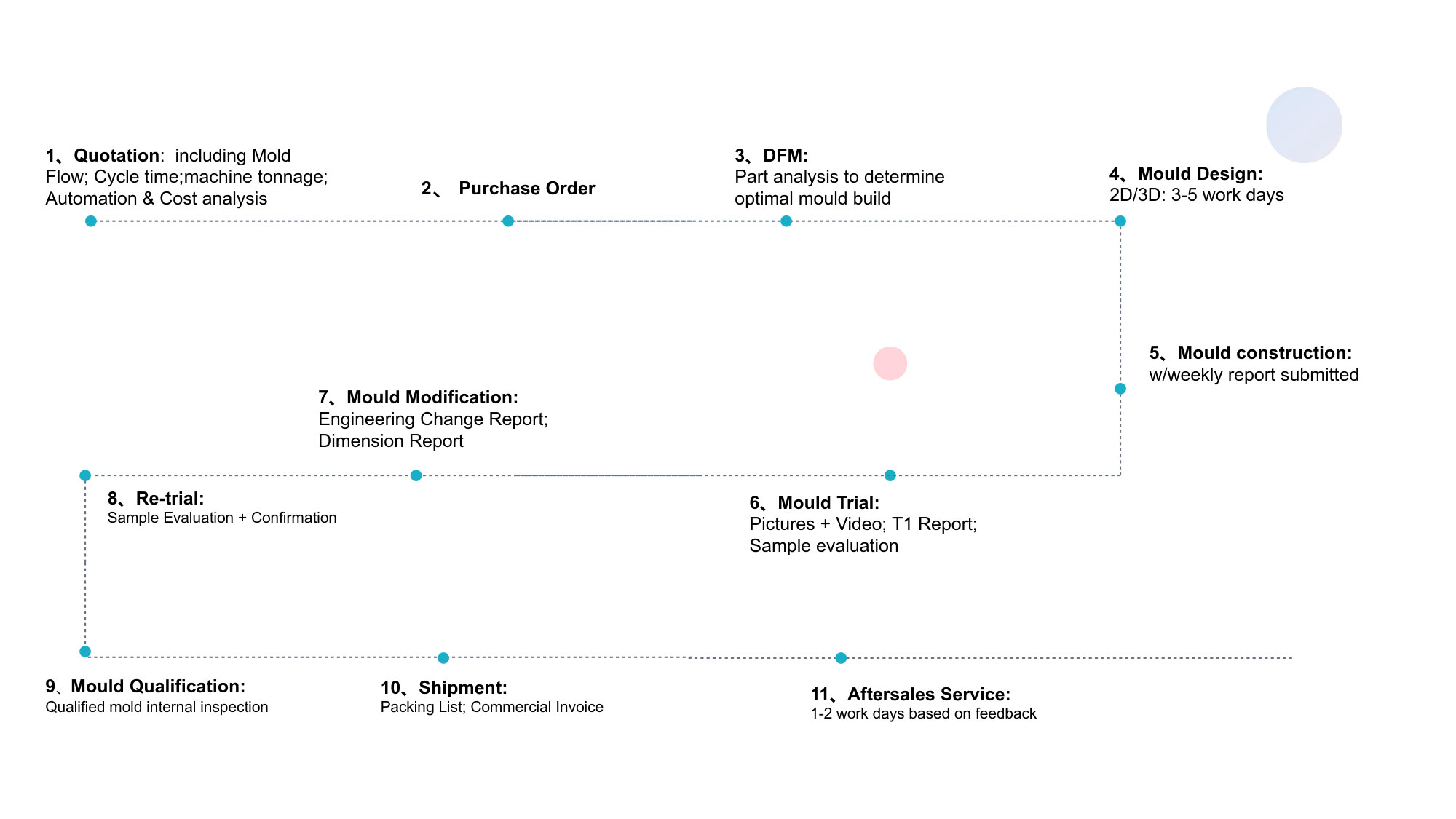
Mold design and DFM 10–14 days
Mold manufacturing (medium complexity) 25–35 days
Sampling (T0 through T3) 10–15 days
Pilot production (if requested) 5–7 days
Mass production (first container) 15–20 days after mold approval
Steady-state replenishment 30 days from order to shipment
Global Logistics Network
Destination Sea Freight (Typical) Air Freight (Expedited)
US West Coast 14–21 days 3–5 days
US East Coast 21–28 days 3–5 days
Europe (Rotterdam) 21–30 days 3–5 days
Asia-Pacific 7–14 days 2–4 days
We maintain safety stock in Chinese and Vietnam warehouses for scheduled orders—your inventory risk reduced.
Conclusion: A Mold Is Not a Piece of Steel. It’s a Revenue Generator.
Every one of the technical capabilities described above—from ±0.002mm machining precision to conformal cooling design, from MES-integrated process control to CPK≥1.33 dimensional validation—exists for a single purpose:
To reduce your cost per part and eliminate your manufacturing risk.
When we design your 68mm diameter 25g wide-mouth PET preform mold, we are simultaneously planning:
The cooling paths that will give you faster cycles
The exhaust vents that will eliminate burn marks
The temperature balance that will prevent warpage
The gate placement that will minimize post-mold finishing
The cavity layout that will maximize your machine‘s output
The steel selection that will keep you running for millions of parts
We invite you to take one existing product and request a full DFM report from Ansix Tech. You will see, clearly and transparently, how we intend to address every potential risk—weld lines, gas trapping, shrinkage, thin-wall issues, thread distortion—before a single piece of steel is cut.
That is the Ansix Tech difference. That is manufacturing designed for your success.
Contact Information:
Ansix Tech Co., Ltd.
Email: info@ansixtech.com
Website: www.ansixtech.com
28+ years of injection molding expertise | 30,000+ molds delivered | 260 injection molding machines | Four manufacturing bases
*For inquiries regarding 68mm diameter 25g wide-mouth PET tube preforms with special threaded nozzle geometry, please request a DFM review using your product specification sheet. We respond within 24 hours.
Ansix Tech Co Ltd
If you have any plans related to 68mm diameter 25g wide-mouth PET plastic tube preform for skincare bottle blow molding special threaded nozzle bottle preform , you can contact us at any time. We will turn your ideas into reality, let you realize your dreams, and obtain large orders from the market. Our contact information is info@ansixtech.com. Or contact our CTO, mail: stephen@ansixtech.com
#www.ansixtech.com #ansixtech.com #68mm diameter 25g wide-mouth PET plastic tube preform #68mm diameter 25g wide-mouth PET plastic tube preform #68mm diameter 25g wide-mouth PET plastic tube preform injection molding companies #68mm diameter 25g wide-mouth PET plastic tube preform Canopy Mold injection mold companies #Ansix #Ansix moulds #Ansix china #Ansix tech china #Ansix tech company #Ansix facotry #68mm diameter 25g wide-mouth PET plastic tube preform injection molding #68mm diameter 25g wide-mouth PET plastic tube preform injection tools #68mm diameter 25g wide-mouth PET plastic tube preform injection moulds #68mm diameter 25g wide-mouth PET plastic tube preform plastic mould #68mm diameter 25g wide-mouth PET plastic tube preform plastic tools #Ansix Tech #Ansix molds #Ansix injection molding #Ansix mold factory #injection molding 68mm diameter 25g wide-mouth PET plastic tube preform #Ansix mold factory #68mm diameter 25g wide-mouth PET plastic tube preform china #68mm diameter 25g wide-mouth PET plastic tube preform molds #injection factory #68mm diameter 25g wide-mouth PET plastic tube preform injection molding #68mm diameter 25g wide-mouth PET plastic tube preform injection molding factory #injection molding company #68mm diameter 25g wide-mouth PET plastic tube preform injection mold companies #68mm diameter 25g wide-mouth PET plastic tube preform#68mm diameter 25g wide-mouth PET plastic tube preform mold limited #Ansix mold china #Ansix companies #Ansix company China #68mm diameter 25g wide-mouth PET plastic tube preform facotry #Ansix Tech #Ansix Tech mould #68mm diameter 25g wide-mouth PET plastic tube preform injection moulding #injection moulding company #Ansix 68mm diameter 25g wide-mouth PET plastic tube preform parts injection mold companies #medical injection molding companieschina #68mm diameter 25g wide-mouth PET plastic tube preform china factory #Ansix moulding companies #Ansix molding company #68mm diameter 25g wide-mouth PET plastic tube preform injection moulding facotry #Ansix Tech mold #68mm diameter 25g wide-mouth PET plastic tube preform mould #68mm diameter 25g wide-mouth PET plastic tube preform plastic injection molding #ansix plastic mold #Mold manufacturing #68mm diameter 25g wide-mouth PET plastic tube preform parts manufacturing #68mm diameter 25g wide-mouth PET plastic tube preform plastic parts factory #68mm diameter 25g wide-mouth PET plastic tube preform injection parts mold #68mm diameter 25g wide-mouth PET plastic tube preform PRECISION MANUFACTURING #68mm diameter 25g wide-mouth PET plastic tube preform #China mold #68mm diameter 25g wide-mouth PET plastic tube preform injection moulding china #68mm diameter 25g wide-mouth PET plastic tube preform mould china #china precision mold #mold in china #68mm diameter 25g wide-mouth PET plastic tube preform mold china #Precision molds #High-precision molds #68mm diameter 25g wide-mouth PET plastic tube preform #Injection molds #68mm diameter 25g wide-mouth PET plastic tube preform Factory #68mm diameter 25g wide-mouth PET plastic tube preform Company #Super Large Injection Mold Factory #Large Tonnage Injection Molding Factory #68mm diameter 25g wide-mouth PET plastic tube preform Company #68mm diameter 25g wide-mouth PET plastic tube preform Factory #2800T Injection Molding Factory #3000 Ton Injection Molding #4500 Ton Injection Molding Factory #Large Mold Injection Molding #Large Plastic Mold Injection Molding Factory #Large Injection Mold Manufacturer #Plastic Mold Factory #Injection Mold #Plastic Mold