



LSR Liquid Silicone Breast Pump Lid
FEATURES
Hard Infrastructure: Building Unshakeable Customer Trust
Every customer asks the same question: “Can you deliver what you promise, consistently?” Our answer begins with the hardware foundation.
Mold Manufacturing Equipment – Where Precision Begins
Equipment Type Technical Specification What This Means for You
5‑Axis High‑Speed Machining Centers Achieves 0.002 mm contouring accuracy; capable of machining complex 3D core/cavity geometries Your breast pump lid`s parting line will be smooth and flash‑free — no manual trimming, no product irritation against skin |
Slow‑Wire EDM Achieves 0.03 mm narrow slots and micro‑holes; prevents thin‑wall distortion Enables intricate sealing ribs and snap features without compromising structural integrity
Mirror EDM & Precision Grinding Surface finish Ra ≤ 0.05 μm on cavity surfaces Results in a glossy, non‑stick finish that releases easily and looks premium — critical for consumer‑facing medical products
Coordinate Measuring Machine (CMM) Full dimensional inspection before mold shipment Every mold ships with a complete dimensional report — you get objective proof, not promises
Optical Digital Comparator Non‑contact measurement of delicate features Protects fine silicone ribs from measurement‑induced deformation
Our approach is simple: We machine the mold right the first time so you don`t have to fix parts later.
-
Mold Description
Product Materials:
LSR SILICONE
Soft rubber: LSR
Mold Material:
S136ESR
Number of Cavities:
2
Glue Feeding Method:
Hot runner
Cooling Method:
Water cooling
Molding Cycle
12.5s
- The mold manufacturing process and product material selection
Injection Molding Machine Fleet – Precision at Scale
Parameter Ansix Tech Capability Value Delivered
Machine range 30 to 2,800 tons Covers everything from single‑cavity prototypes to 128‑cavity high‑volume production
Key brands Fanuc, Sumitomo, Toshiba, Nissei, Engel, Arburg World‑class repeatability — each shot mirrors the last
Drive technology All‑servo electric drives Reproducibility ±0.1% — your breast pump lids will be dimensionally identical across millions of cycles
LSR‑dedicated lines Arburg LSM systems Precision mixing (A:B ratio within ±0.5% ), cold‑runner compatibility, vacuum degassing
Cleanroom environment ISO 8 (Class 100,000) cleanroom Meets medical‑grade cleanliness requirements; no post‑mold contamination risks
The language we speak: Stability, repeatability, traceability. The value you receive: No unexpected dimension drift, no sudden flash issues, no costly production revalidations.
-
Inspection & Metrology – Proof Before Shipment
CMMs with full‑length probe systems
Optical vision systems for non‑contact measurement
Surface roughness testers (Ra / Rz)
Hardness testers (Shore A)
Tensile/tear strength testers for LSR material validation
Every outgoing mold undergoes a full dimensional check. Critical features are tracked with Cpk ≥ 1.33 — meaning 99.7%+ of your production will remain within tolerance without intervention.
“Trust is earned through transparency. We deliver a complete inspection report with every mold.”
Section 2 – Mold Manufacturing: Core Competitiveness by the Numbers
Your breast pump lid mold is the single most leveraged asset in your production chain. A great mold runs for years; a compromised mold costs you endless downtime, rework, and scrap. Below is how we define the difference.
2.1 Mold Life Expectancy – From Committed Steel to Guaranteed Cycles
Mold Component Material Grade Industry‑Standard Life Ansix Tech Guaranteed Life Customer Value
Mold base / Plates P20 / 50C 500,000 cycles 1,000,000+ cycles (thermoplastics) Lower per‑part tooling amortization
Mold core / Cavity (LSR) S136 / H13 / 2344 / 2343 100,000‑200,000 cycles 500,000+ cycles with proper maintenance Fewer mold rebuilds = lower long‑term cost
Corrosion‑resistant option M340 / 4Cr13 / 9Cr18 300,000 cycles 750,000+ cycles Ideal for frequent sterilization environments
Mirror‑finish / optical grade NAK80 / H13 (mirror polish) 250,000 cycles 500,000+ cycles Flawless surface appearance = premium brand image
High‑wear / glass‑filled materials SKD11 / DC53 / 8407 200,000 cycles 450,000+ cycles Stable dimensions even with abrasive fillers
For medical‑grade LSR breast pump lids, we specifically recommend S136 or H13 stainless steel for the core/cavity — offering outstanding corrosion resistance, excellent polishability to Ra ≤ 0.05 μm, and long service life under repeated high‑temperature sterilization. Each mold ships with:
Material mill certificates (traceable to heat numbers)
Heat treatment curves (hardness, depth, tempering cycles)
Coating specifications (when applicable)
“We don`t guess the steel. We certify it.”
2.2 Tolerances That Matter
Feature Category Standard Tolerance Precision Capability Customer Impact
General structural features (bosses, ribs) ±0.05 mm ±0.03 mm Assembly‑ready parts — no “hand‑fitting”
Critical sealing surfaces / snap‑fit features ±0.02 mm ±0.01 mm Guaranteed leak‑proof seal against pump body
Fine detail / text / micro‑geometry ±0.01 mm ±0.005 mm (select cases) Brand logos, graduations, or tactile features remain legible after millions of cycles
Our parting line fit is built to 0.005 mm or tighter — because LSR will flash at 0.0025 mm gaps, much tighter than thermoplastics. We account for that difference at the machining stage, not at your production line.
2.3 Mold Type & Runner System Configuration
Mold Architecture Application for Breast Pump Lid Value to You
Cold runner with needle‑valve shut‑off High‑volume, single‑material LSR lid production Zero runner waste — every gram of LSR becomes a sellable part
Hot runner (without shut‑off) Lower volume, simpler geometry Lower upfront tooling cost; acceptable for prototype or niche product runs
Multi‑cavity (4 / 8 / 16 / 32 cavities) Scalable volume production Cost per part drops 40–60% as cavity count increases
Two‑shot / overmolding mold LSR lid + hard plastic pump interface (e.g., polycarbonate ring) Integrated component = reduced assembly costs + stronger bond
For most breast pump lid projects, we recommend the cold runner + needle‑valve system. Here`s why: LSR is a thermoset — once cured, it cannot be reground or reused. With a cold runner, the material inside the runner stays cold and un‑cured between shots, so nothing is wasted; with valve‑gated shut‑off, you avoid stringing or drooling. The upfront investment in valve gates (approximately USD 500–3,000 per cavity) is quickly recovered through eliminated material waste and faster cycles.
2.4 Gate & Venting Strategy – Engineered Through Simulation
We use Moldex3D and SIGMASOFT® for mold flow analysis before cutting any steel. This is not an optional step — it is a mandatory part of our DFM process.
What we simulate and solve upfront:
Risk What We Predict with Simulation Proactive Solution
Air traps (trapped gas causing burn marks) Exact location of air traps during fill Place vacuum vents exactly where needed; optimize vent depth to 0.001–0.003 inches
Jetting (uncontrolled stream folding over itself) Flow front behavior at different injection speeds Adjust gate location and mold temperature to keep flow front smooth
Imbalanced filling (multi‑cavity variation) Fill time differences between cavities Balance runner diameters and gate sizes so every cavity finishes together
Premature curing (scorching) Temperature rise during fill Cool the runner sufficiently and adjust injection speed to prevent heat buildup
Weld / knit lines Flow front convergence points Relocate weld lines to non‑critical areas (away from sealing or visible zones)
Value statement: You avoid 3–5 rounds of physical mold trials to fix defects that can be identified and eliminated in the virtual world. That translates to weeks saved in development time and thousands of dollars in avoided prototype costs.
2.5 Cooling System / Water Circuit – Temperature Uniformity Is Everything
LSR cures exothermically (it releases heat as it cross‑links). Uneven mold temperatures cause uneven cure, leading to part warpage, dimension drift, and extended cycle times.
Our design approach:
Conformal cooling channels (as geometry allows) to follow the part contour
Partitioned water circuits with independent flow and temperature control for core vs. cavity
Targeted heating cartridges in cavity plates to maintain 150–200°C mold surface temperature
Temperature difference between core and cavity maintained ≤ 2°C
We simulate the thermal behavior using SIGMASOFT® to verify that heating zones are correctly sized and placed, eliminating “cold spots” that delay cure or “hot spots” that cause scorching.
“You get a thermally balanced mold that cures every part in the same time, every cycle, without warp.”
2.6 Delivery Commitments – Dependable and Clear
Mold Complexity Standard Lead Time Express Lead Time (with conditions) Quality Assurance
Simple breast pump lid (single cavity, no slides) 10–15 days — Full dimensional report
Medium complexity (multi‑cavity cold runner, basic shut‑offs) 25–35 days 20 days Full dimensional + first‑article inspection
High complexity (overmolding / two‑shot, complex shut‑offs, 16+ cavities) 40–55 days 28–32 days Full dimensional + first‑article + CPK ≥ 1.33
Express delivery conditions: We do not skip DFM validation or T0 sampling. Instead, we allocate parallel machining resources and double shifts. Your quality is never compromised for speed.
Post‑delivery support: Each mold ships with a spare parts kit (critical pins, cores, heaters). We provide scheduled mold maintenance at 200,000‑cycle intervals and ongoing repairs at cost‑plus pricing.
Section 3 – Injection Molding Process Control: Eliminating Production Anxiety
Customers consistently worry about flash, short shots, dimensional drift, cosmetic defects, and inconsistent cures. Below is how we systematically eliminate each risk through process engineering and real‑time controls.
3.1 Process Standardization – MES‑Locked Parameters
All machine parameters (temperatures, injection speeds, pressures, cure times, shot volumes) are locked in MES (Manufacturing Execution System)
Only senior engineers can approve parameter changes, with full audit trail
Each batch: First‑article inspection (dimension + appearance) and last‑article comparison
What this means for you: Your parts do not change “because a night shift operator adjusted something.” The process is frozen and replicable across shifts, machines, and production runs.
3.2 Dimensional Stability – Beyond Conventional Molding
Challenge Ansix Tech Control Strategy Measurable Outcome
Warpage / shrinkage Zone‑controlled mold temperature (core/cavity ΔT ≤ 2°C) + post‑cure stabilization at 150–200°C for 2–4 hours (medical grade) Flange flatness variation < 0.05 mm across entire lid perimeter
Cycle‑to‑cycle dimension drift In‑mold pressure and temperature sensors feeding back to injection unit for real‑time compensation Critical diameter dimension ±0.02 mm across 1,000 consecutive shots
Batch‑to‑batch variation Standardized curing time per part thickness: 10–15 seconds per 1 mm thickness + additional 5–10 seconds per extra mm Batches made weeks apart are statistically identical
3.3 Cosmetic & Surface Quality Levels
Requirement Achievable Standard Typical Applications
Standard appearance No visible flow marks, no bubbles > 0.5 mm Non‑visible internal surfaces
Medical / baby‑contact surface Transparent / translucent parts: no bubbles, no flow marks, Ra ≤ 0.2 μm; opaque: Ra ≤ 0.4 μm Lid surface contacting breast milk or infant skin
High‑gloss / optical Polished mold cavity Ra ≤ 0.05 μm; part surface Ra ≤ 0.1 μm Premium / luxury product lines
For printed / branded lids, we reserve ±0.1 mm compensation for graphic alignment — ensuring your logo stays centered and legible after molding.
3.4 Material Capabilities – Proven Across Medical & Consumer Applications
Material Type Specific Grades We Process Key Properties for Breast Pump Lid
LSR – fast‑cure, high tear Silopren® LSR 4840 (Momentive) Fast cure (cycles 10–90 seconds), high tear strength, USP Class VI, ETO / steam / gamma sterilizable
LSR – self‑bonding to PC/PBT Silopren® LSR 4749 / 4759 Direct adhesion to polycarbonate pump bodies without primers — reduces overmolding steps
Medical‑grade ultra‑low durometer SILBIONE® LSR 4340 FC (Elkem) Very soft, flexible sealing lip — ideal for gentle breast contact
Typical thermoplastic substrates for overmolding PC, ABS, PBT, PA6+GF30 Rigid pump body compatibility
Specialty engineering materials PEEK, PEI, PPS, LCP For high‑temperature / repeated sterilization environments
All LSR materials are biocompatible and compliant with ISO 10993 and USP Class VI standards — essential for medical and infant‑contact products.
3.5 Flash Control – The Silent Cost Killer
Flash on a breast pump lid is unacceptable for two reasons: it creates a rough edge against sensitive skin, and it adds manual trimming labor.
Parameter Industry Typical Ansix Tech Standard How We Achieve It
Parting line gap 0.010 – 0.025 mm ≤ 0.005 mm 5‑axis precision machining + matched shut‑off surfaces
Flash thickness after molding 0.05 – 0.10 mm (requires trimming) < 0.03 mm (no trimming needed) Parting line lapping + precision mold alignment
Process drift prevention Manual observation Automated clamp‑force monitoring + real‑time compensation Machine self‑adjusts to maintain minimal flash
Financial impact: Eliminating manual flash trimming saves USD 0.02 – 0.08 per part in labor. On a million‑part annual volume, that is USD 20,000 – 80,000 of direct cost savings.
Section 4 – Full‑Service Lifecycle Management: Reducing Your Management Burden
Most customers tell us: “We don`t want to manage multiple vendors for mold, production, coating, and assembly.” Our one‑stop model solves that.
4.1 Early Engagement – DFM (Design for Manufacturability) Report
Before you commit to tooling, we deliver a comprehensive DFM report:
DFM Element Questions We Answer For You
Draft angles Are the current drafts sufficient for LSR release? Recommended minimum 1–3 degrees
Wall thickness Is the wall thickness uniform? LSR flows best with 0.5–3.0 mm walls; abrupt changes cause flow hesitation
Gate location Where should the gate(s) be placed to minimize weld lines and avoid visible surfaces?
Ejector pin marks Where will ejector pins contact the part? Can we locate them in non‑cosmetic areas?
Parting line Where should the parting line be positioned for easiest flash control and mold construction?
Undercuts Do any features require slides or lifters? What is the added cost and lead time?
Value delivered: You avoid finding out “the part cannot be molded as drawn” after USD 30,000+ has already been spent on tooling. Our DFM phase typically saves 2–4 weeks of redesign cycle and prevents 80% of common molding defects before steel is cut.
4.2 Trial Molding & Iterative Sampling – T0 to T3
Sampling Stage Deliverable Customer Action
T0 (first shot) First physical parts from the mold; preliminary dimensional report Review appearance, fit, and basic function
T1 Mold adjustments completed (if needed); first‑article inspection Functional and assembly testing
T2 Process window defined (temperature, pressure, cure time ranges) Reliability / qualification testing
T3 Molding parameters locked; CPK report generated Approval for pilot / production run
Between stages, we provide written improvement reports detailing what was modified and why. We can also produce rapid interchangeable inserts to test multiple gate/vent configurations without building a second mold.
4.3 Pilot Run (100–500 shots) – Validation Before Scale
Before committing to full mass production, we run a statistically meaningful pilot batch:
Yield % documented
CPK ≥ 1.33 demonstrated
Process capability (Cp, Cpk) formally reported
Any edge‑case defects identified and resolved
Only after you approve the pilot results do we proceed to sustained production.
4.4 Maintenance & Spare Parts – Long‑Term Partnership
Service Frequency / Policy
Spare parts kit (critical ejector pins, core inserts, heaters) Shipped with the new mold — no waiting weeks for replacement parts
Preventative mold maintenance Every 200,000 cycles (disassembly, cleaning, lubrication, measurement check)
Emergency repair 24‑hour response for production‑stopping issues; in‑house EDM and CNC for rapid fixes
Long‑term repair cost Cost‑plus pricing (no mark‑up on replacement parts)
Value statement: You never experience the “our mold is down and we cannot get spare parts for three weeks” scenario.
Section 5 – Differentiators: Direct Answers to Common Industry Pain Points
Customer Complaint (Observed in the Market) Ansix Tech`s Specific Response (Deliverable)
“My mold keeps breaking — I`m constantly repairing it.” | We run a 2,000‑shot mold validation before delivery, measuring wear and providing a wear report. We also offer a three‑year structural warranty on the mold (excluding normal wear items). |
“Every batch has flash, so I pay operators to trim it.” We build the parting line to 0.005 mm precision and use servo‑controlled clamp‑force compensation. Result: Flash is kept under 0.03 mm — so thin it typically does not require any manual trimming.
“Dimensions drift after a few thousand parts — I scrap 10%.” We install in‑mold pressure and temperature sensors that feed back to the injection control system and adjust parameters in real time. For critical dimensions, we add ultrasonic wall‑thickness sensors. Drift is compensated before it creates rejects.
“My mold repair cycle takes weeks — production stops.” We maintain a complete in‑house electrode manufacturing and EDM department; most repairs (weld, recut, or insert replacement) are completed within 24 hours.
“I cannot trust offshore vendors — I worry about quality.” We ship each mold with a full dimensional report and material certificates. All processes are ISO 13485 (medical devices) and FDA 510K compliant, with an ISO 8 Cleanroom and full traceability. Many of our customers are medical device OEMs with the same concerns — and we have served them successfully for decades.
“My parts smell or taste like silicone — consumers complain.” We specify platinum‑cured LSR (medical grades) instead of peroxide‑cured silicone. Platinum‑cured LSR has no residual peroxide by‑products, eliminating odor and taste issues. We also perform post‑cure at 150–200°C for 2–4 hours to remove volatiles to levels meeting FDA and EU food‑contact standards.
Section 6 – Cost Optimization: How We Deliver Competitive Pricing Without Sacrificing Quality
Cost is not simply a number — it is a function of material efficiency, cycle time, labor content, and tooling amortization. Here is how we systematically attack each variable.
6.1 Material Cost Reduction
Strategy Method Estimated Savings
Cold runner with valve gates Eliminates runner waste entirely compared to hot runners without shut‑off 15–25% material cost savings vs. runner‑waste systems
Multi‑cavity mold Spreads injection cycle output across 4, 8, 16, 32, 64, or 128 cavities Per‑part mold amortization reduces as cavity count increases; machine time per part drops proportionally
Precision shot control Dosing systems maintain A:B ratio ±0.5% , preventing scrap from off‑ratio cures Reduces scrap rate by 30–50% compared to manual / low‑precision dosing
Direct negotiation with material suppliers Annual purchasing of 10+ metric tons of medical LSR allows favorable pricing 5–12% lower raw material cost than small‑volume buyers
6.2 Cycle Time Reduction
Parameter Industry Average Ansix Tech Optimized Savings Per Part
Typical LSR cycle time (breast pump lid) 45–90 seconds 30–55 seconds (depending on geometry) 25–40% reduction in machine time cost
Cure time optimization Fixed cure time schedule Cure time tuned per geometry via simulation — only as long as necessary 10–20 seconds saved per cycle
Automated demolding Manual removal Robotic pick‑and‑place directly from open mold Labor cost reduced to near‑zero for demolding
Financial impact: On a high‑volume product (2 million parts/year), reducing cycle time from 60 seconds to 40 seconds increases effective production capacity by 50% — effectively cutting per‑part machine cost by one‑third.
6.3 Process Efficiency Optimization
MES‑locked parameters eliminate operator‑induced variation — no scrap from “someone changed a temperature setting”
Automatic leak detection systems identify off‑ratio mixing or air entrainment within the first shot, preventing hours of out‑of‑spec production
Inline automated vision inspection identifies dimensional or surface defects at 100% inspection rate — bad parts do not reach packaging
Result: Our typical first‑pass yield for LSR breast pump lids is 96–99% after process qualification. Lower scrap means lower per‑part material and labor cost.
6.4 Vertical Integration Savings
Service If Outsourced Separately With Ansix Tech One‑Stop
Mold design & DFM $5,000 – 15,000 Included in tooling price
Mold manufacturing $25,000 – 60,000+ One invoice, no interface management
Material purchasing Mark‑up from distributor Direct mill pricing passed to you
Injection molding production Separate per‑part pricing Integrated costing — no margin stacking
Post‑mold assembly / packaging Another vendor’s margin We assemble and package under one roof
Customers typically save 15–30% total landed cost compared to managing mold maker + molder + assembly house separately.
Section 7 – Detailed Process Flow: LSR Breast Pump Lid from Concept to Shipment
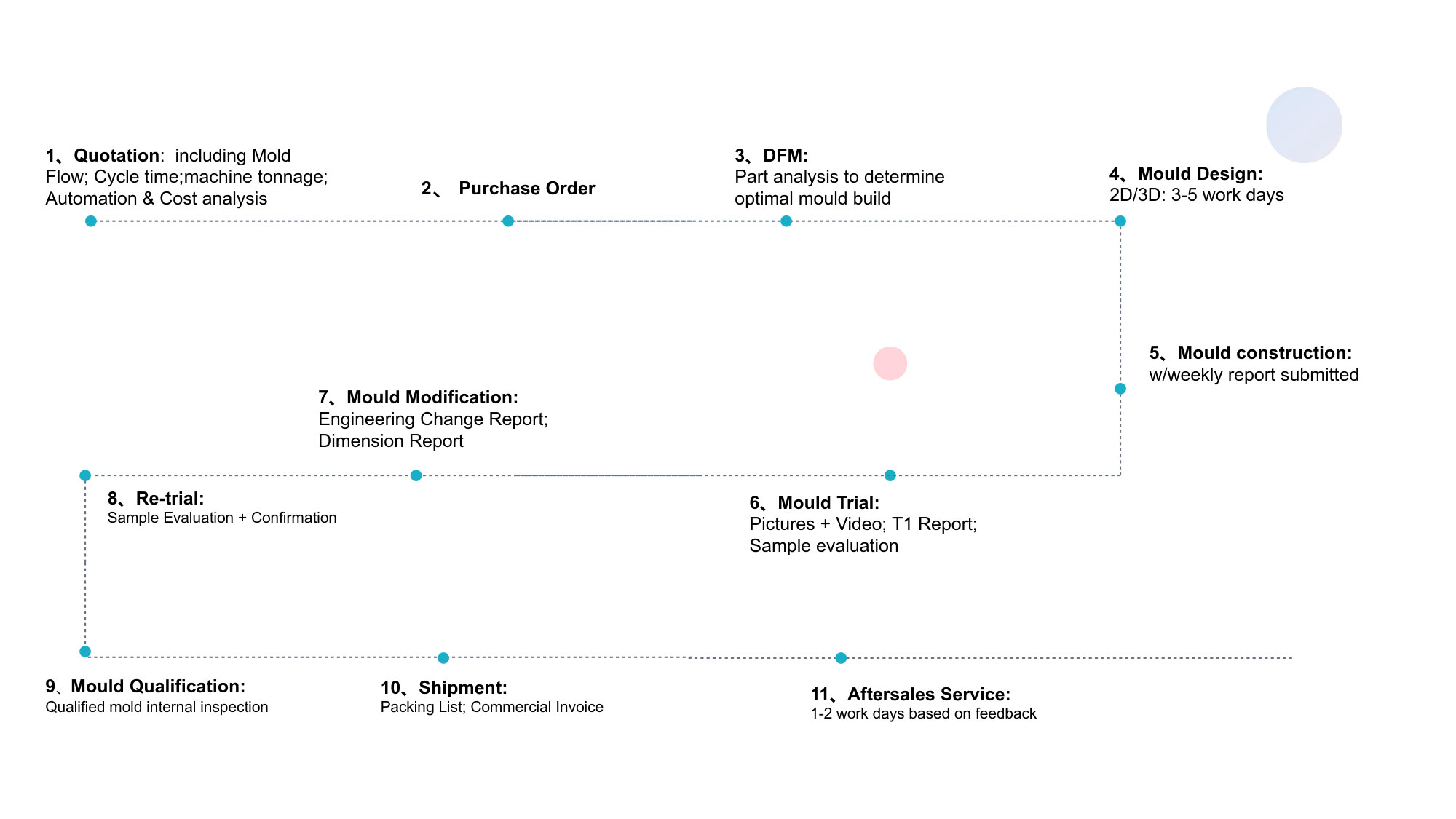
Below is the end‑to‑end process that every Ansix Tech LSR breast pump lid project follows — with clear quality gates and decision points.
Phase 1: Project Initiation & DFM (Days 0–7)
Receive 3D CAD model and initial specifications (material, volume, target cost, quality standards)
DFM review: Draft analysis, wall thickness uniformity, gate placement, undercuts, shrink rate estimation, ejector location proposal
Mold flow analysis (Moldex3D / SIGMASOFT):
Simulate filling: Identify air traps, weld lines, jetting
Simulate curing: Estimate cure time, verify thermal uniformity
Simulate cooling: Verify circuit effectiveness
Mold construction proposal: Cavity count, runner type (cold runner + valve gates recommended), cooling circuit layout, materials list (S136 core / cavity)
Cost estimate and lead time commitment
Customer approval to proceed
Phase 2: Mold Manufacturing & Assembly (Weeks 2–6)
Mold base machining (P20 / 50C): CNC milling, grinding
Core / cavity manufacturing (S136 / H13):
Heat treatment to specified hardness (typically 48–52 HRC for LSR tools)
5‑axis CNC roughing + finishing to ±0.005 mm tolerance
EDM for fine detail, narrow slots, shut‑off surfaces
Mirror polishing to Ra ≤ 0.05 μm on cavity surfaces
Cooling system drilling: Water channels, baffles, bubblers as designed
Heater installation: Cartridge heaters in cavity plate, temperature sensor placement
Cold runner / valve gate assembly: Nozzles, shut‑off pins, cooling manifolds
Mold assembly and fit checking
CMM full dimensional inspection — complete report generated
Mold shipment to injection molding floor for T0 sampling
Phase 3: T0 – T3 Trial Molding (Weeks 7–9)
Trial Objective Deliverable
T0 First shot; verify basic filling, ejection, and mold integrity Physical samples; visual inspection; flash & fill observation
T1 Optimize gate/vent after T0 findings; refine process window Updated mold (if modifications needed); initial CPK estimate
T2 Fine‑tune temperatures, pressures, cure times; verify cycle time Process parameter document; first‑article inspection report
T3 Lock parameters; run extended sample (50–100 shots) Final CPK report (≥1.33); customer sample approval
Gate: Customer approves T3 samples before proceeding to pilot production.
Phase 4: Pilot Production (100–500 shots)
Run at intended production settings
100% dimensional inspection on pilot batch
Yield % documented
Process capability confirmed
Any remaining issues resolved
Gate: Customer approves pilot results → formal production authorization.
Phase 5: Mass Production (Sustained Run)
Material preparation: LSR A/B components received from approved supplier (e.g., Momentive / Dow / Shin‑Etsu / Elkem / Wacker)
Dosing & mixing: High‑precision gear pumps + static mixer; ratio control ±0.5%; vacuum degassing 5–15 minutes to remove entrained air
Injection: Cold runner with needle‑valve shut‑off; injection pressure 50–150 bar; speeds 50–100 mm/s initial fill
Curing: Mold temperature 170–200°C; cure time 30–55 seconds depending on wall thickness; exothermic reaction self‑completes cross‑linking
Demolding: Automatic ejection + robotic pick‑and‑place; air‑assist ejection for sticky LSR parts
Post‑cure (medical grade): 150–200°C oven for 2–4 hours to complete cross‑linking and remove volatiles
Deflashing: If any residual flash exists (typically under 0.03 mm, often none), cryogenic or manual methods employed
100% inline inspection: Vision systems for dimension and surface defects
Packaging: Sealed clean bags; lot traceability labeling
Warehousing & shipping: Coordinated logistics from China / Vietnam plants
Phase 6: Quality Assurance – Throughout Production
Quality Activity Frequency Standard
Incoming material testing (viscosity, hardness, cure rate) Each batch Supplier certificate + internal verification
In‑process parameter verification Every shift MES‑locked; automated alarm on deviation
First‑article inspection Per batch / per mold Full dimension check (CMM)
Patrol inspection Every 2 hours (during sustained runs) Key dimensions (calipers) + visual
Last‑article comparison Per batch end Compare to first‑article data
CPK trending Weekly Top 5 critical dimensions tracked
Cleanroom particle count Continuous ISO 8 (Class 100,000)
Biocompatibility testing (if required) Per lot / per validation ISO 10993, USP Class VI
Phase 7: Packaging & Fast Delivery
Clean packaging: Sealed clean bags (cleanroom grade) with lot traceability
Multi‑plant capacity: Four production bases (China + Vietnam) offer geographic redundancy and shipping flexibility
Express options: For urgent orders, we can compress lead times via parallel production and priority logistics lanes
Supply chain agreements: Long‑term relationships with logistics partners ensure scheduled pick‑ups and on‑time delivery
Section 8 – Manufacturing Process Excellence: Proven Through Real Results
8.1 Proven Experience Across Medical LSR Applications
Ansix Tech has successfully delivered LSR injection molding solutions for:
Medical catheters and tubing — requiring ultra‑clean processing and tight dimensional tolerances
Respiratory masks and accessories — complex geometries, comfort‑critical interfaces
Surgical device protective covers — thin‑wall, high‑tear LSR
Seals and gaskets — demanding compression‑set performance
Overmolded medical components — LSR bonded to PC or ABS substrates
This breadth of experience means we bring proven process libraries and problem‑solving expertise to your breast pump lid project — not theoretical capabilities.
8.2 Why Breast Pump Lid Is a Natural Fit for Our Process
Breast Pump Lid Requirement Ansix Tech Capability
Soft, skin‑friendly sealing lip LSR hardness ranging from Shore A 20 to 60
Sterilizable (boiling water, steam, ETO, gamma) Platinum‑cured LSR with full sterilization validation
Leak‑proof interface with pump body Precision shut‑off surfaces maintained ±0.01 mm
High‑volume, cost‑sensitive Multi‑cavity cold runner tooling with 30–55 second cycles
FDA / ISO 10993 compliance ISO 13485 facility, Class 100,000 cleanroom, material certificates
Odor‑free, taste‑free Platinum‑cured LSR + post‑cure
8.3 Risk Mitigation: What You Will Not Experience With Ansix Tech
Risk Mitigation Strategy
Mold does not fill correctly DFM + mold flow analysis performed before steel cut — validated virtually
Mold life is too short High‑grade steel + heat treatment + hardness certification + 2,000‑shot validation before shipment
Part dimensions drift over time In‑mold sensors + closed‑loop control; CPK monitored weekly
Batch‑to‑batch color variation Precision LSR pigment dosing (color paste injection) + MES tracking
Supply chain disruption Dual‑sourcing agreements; four production bases in two countries
Regulatory non‑compliance ISO 13485 QMS; FDA 510K facility registration; material traceability
Section 9 – Conclusion: Why Ansix Tech Is Your Partner for LSR Breast Pump Lid Manufacturing
To our customers, a mold is not a block of steel — it is a profit‑generating asset. We design every mold with simultaneous consideration of:
Flow behavior (filling balance, gas evacuation)
Thermal management (cure uniformity, cycle time)
Mechanical integrity (parting line precision, wear resistance)
Production robustness (low flash, stable dimensions, long life)
The result: A mold that arrives at your production line ready to run — not needing weeks of debugging, not producing excessive flash, not drifting out of spec after 50,000 cycles.
Measurable Value Summary
Customer Concern Ansix Tech Solution Quantified Benefit
Mold durability S136/H13 steel + heat treat 500,000+ cycles before significant wear
Dimensional stability Closed‑loop process control Critical dimensions ±0.02 mm batch‑to‑batch
Cosmetic quality Ra ≤ 0.05 μm mold finish + platinum LSR No bubbles, no flow marks on visible surfaces
Flash elimination Parting line 0.005 mm fit Flash < 0.03 mm — usually no trimming needed
Material waste elimination Cold runner + valve gate 15–25% material cost savings
Regulatory compliance ISO 13485 + FDA 510K + ISO 8 Cleanroom Medical‑device ready out of the box
Delivery confidence 260 injection molding machines, 4 plants Flexible capacity to meet your volume and timeline
Final Note
We invite you to select an existing product — yours or a standard reference part — for a full DFM case study walkthrough. We will demonstrate, using actual mold flow simulation and engineering analysis, precisely how we would anticipate and resolve:
Weld line and flow front behavior
Air trap locations and venting strategy
Shrinkage and warpage compensation
Cooling system layout for uniform cure
Gate placement for minimal visible marks
When you see the simulation before the steel is cut, you will understand why we can offer the guarantees we do. That is the Ansix Tech difference.
Contact: Ansix Tech – Medical Injection Molding Division
28 Years of Experience | ISO 13485 | ISO 8 Cleanroom | FDA 510K | Global Manufacturing Footprint
Ansix Tech Co Ltd
If you have any plans related to LSR Liquid Silicone Breast Pump Lid , you can contact us at any time. We will turn your ideas into reality, let you realize your dreams, and obtain large orders from the market. Our contact information is info@ansixtech.com. Or contact our CTO, mail: stephen@ansixtech.com
#www.ansixtech.com #ansixtech.com #LSR Liquid Silicone Breast Pump Lid #LSR Liquid Silicone Breast Pump Lid injection molding companies #LSR Liquid Silicone Breast Pump Lid Canopy Mold injection mold companies #Ansix #Ansix moulds #Ansix china #Ansix tech china #Ansix tech company #Ansix facotry #LSR Liquid Silicone Breast Pump Lid injection molding #LSR Liquid Silicone Breast Pump Lid injection tools #LSR Liquid Silicone Breast Pump Lid injection moulds #LSR Liquid Silicone Breast Pump Lid plastic mould #LSR Liquid Silicone Breast Pump Lid plastic tools #Ansix Tech #Ansix molds #Ansix injection molding #Ansix mold factory #injection molding LSR Liquid Silicone Breast Pump Lid#Ansix mold factory #LSR Liquid Silicone Breast Pump Lid china #LSR Liquid Silicone Breast Pump Lid molds #injection factory #LSR Liquid Silicone Breast Pump Lid injection molding #LSR Liquid Silicone Breast Pump Lid injection molding factory #injection molding company #LSR Liquid Silicone Breast Pump Lid injection mold companies #LSR Liquid Silicone Breast Pump Lid Tooling #LSR Liquid Silicone Breast Pump Lid mold limited #Ansix mold china #Ansix companies #Ansix company China #LSR Liquid Silicone Breast Pump Lid facotry #Ansix Tech #Ansix Tech mould #LSR Liquid Silicone Breast Pump Lid injection moulding #injection moulding company #Ansix LSR Liquid Silicone Breast Pump Lid parts injection mold companies #medical injection molding companieschina #LSR Liquid Silicone Breast Pump Lid china factory #Ansix moulding companies #Ansix molding company #LSR Liquid Silicone Breast Pump Lid injection moulding facotry #Ansix Tech mold #LSR Liquid Silicone Breast Pump Lid mould #LSR Liquid Silicone Breast Pump Lid plastic injection molding #ansix plastic mold #Mold manufacturing #LSR Liquid Silicone Breast Pump Lid parts manufacturing #LSR Liquid Silicone Breast Pump Lid plastic parts factory #LSR Liquid Silicone Breast Pump Lid injection parts mold #LSR Liquid Silicone Breast Pump Lid PRECISION MANUFACTURING #LSR Liquid Silicone Breast Pump Lid #China mold #LSR Liquid Silicone Breast Pump Lid injection moulding china #LSR Liquid Silicone Breast Pump Lid mould china #china precision mold #mold in china #LSR Liquid Silicone Breast Pump Lid mold china #Precision molds #High-precision molds #LSR Liquid Silicone Breast Pump Lid #Injection molds #LSR Liquid Silicone Breast Pump Lid Factory #LSR Liquid Silicone Breast Pump Lid Company #Super Large Injection Mold Factory #Large Tonnage Injection Molding Factory #LSR Liquid Silicone Breast Pump Lid Company #LSR Liquid Silicone Breast Pump Lid Factory #2800T Injection Molding Factory #3000 Ton Injection Molding #4500 Ton Injection Molding Factory #Large Mold Injection Molding #Large Plastic Mold Injection Molding Factory #Large Injection Mold Manufacturer #Plastic Mold Factory #Injection Mold #Plastic Mold