



LSR Liquid Silicone Gasket
FEATURES
Hard Power Infrastructure – The Foundation of Customer Trust
Precision Mold Manufacturing Equipment
At Ansix Tech, our tooling capabilities set the foundation for everything we produce. Our mold processing equipment is specifically selected to address the unique challenges of LSR materials.
Five-Axis High-Speed Machining Centers
We operate advanced five-axis high-speed machining centers capable of achieving 0.002mm precision on complex curved surfaces. For LSR gasket applications, this directly translates into smooth parting lines with no flash burrs – meaning your assembly line workers do not need to spend time trimming or deflashing parts before installation. Every cavity and core is machined to exacting tolerances, ensuring each gasket fits precisely into its designated groove.
-
Mold Description
Product Materials:
LSR SILICONE
Soft rubber: LSR
Mold Material:
S136ESR
Number of Cavities:
16
Glue Feeding Method:
Hot runner
Cooling Method:
Water cooling
Molding Cycle
22.5s
- The mold manufacturing process and product material selection
Slow Wire EDM (Electrical Discharge Machining)
Our slow wire EDM equipment can cut micro-features as fine as 0.03mm for narrow slots and thin-walled sections. For LSR gaskets that incorporate complex geometries or fine sealing lips, this precision prevents thin-wall deformation and ensures consistent sealing pressure across the entire contact surface.
Graphite and Copper Electrode Machining Workshop
Unlike many mold shops that outsource electrode production, Ansix maintains an in-house electrode processing center. This vertical integration means mold modifications and repairs typically stay within our facility – conventional repairs and insert replacements restore production within 24 hours. When a customer needs a design change or discovers a molding issue, we respond without external lead time delays.
Injection Molding Machine Fleet
Ansix Tech operates 260 injection molding machines across four production bases in China and Vietnam, with clamping forces ranging from 30 tons to 2800 tons. Our main LSR molding equipment includes Japan‘s Fanuc, Sumitomo, Toshiba, Nissei, Engel, and Germany’s Arburg (primarily for two-component LSR injection molding).
-
All-Servo Electric Drive Systems
Our all-servo electric machines achieve stable repeatability of ±0.1%. This means every shot in a production batch is consistent – no unexpected dimensional drift, no mid-run quality surprises. For customers running high-volume gasket programs, this consistency translates directly into lower rejection rates and more predictable inventory planning.
Coverage Across Product Dimensions
Our machine range allows us to produce LSR gaskets from miniature medical seals (sub-gram parts) to large-format automotive sealing profiles weighing several hundred grams per piece. We match the right machine size to each project, avoiding both underutilized capacity (wasted overhead) and overstrained equipment (risk of inconsistent quality) .
Inspection and Metrology Equipment
Quality verification begins the moment a mold is completed. We deploy coordinate measuring machines (CMM) and optical imaging inspection systems as standard practice.
Full Dimensional Reporting Before Mold Shipment
Every mold leaving our facility undergoes a complete dimensional inspection with a full report. Key dimensions are verified with CPK ≥ 1.33 before the mold enters production. For LSR gaskets, where sealing performance depends on precise cross-sectional geometry, this pre-delivery validation eliminates field-fit issues later.
In-Process and In-Line Inspection
During production, our systems monitor every cycle. Post-production, CMM verification ensures dimensional compliance. Optical inspection systems scan each gasket surface for visual defects such as flash, voids, or incomplete fill. This layered approach means customers receive parts that work the first time, every time.
Section Two: Mold Manufacturing Core Competitiveness – Real Numbers, Real Commitments
Mold Life Expectancy
Our customers consistently cite mold longevity as a decisive factor in supplier selection. We provide explicit, material-specific commitments:
Material Type Guaranteed Mold Life Customer Value
Standard unfilled LSR 1,000,000+ shots Predictable capital cost per part; no unexpected mold replacement expenses
Mildly abrasive materials 500,000+ shots Extended production runs between maintenance intervals
Multi-cavity cold runner systems Per cavity mapping to ensure uniform flow balance Consistent fill across all cavities; no individual cavity failing prematurely
Our mold bases are built with P20 steel, and our mold cores utilize premium tool steels including S136, 2344, 8407, SKD11, DC53, M340, 4Cr13, 9Cr18, NAK80, and H13 – each selected based on the specific LSR compound and production volume requirements.
Documented Quality Proof: Each mold ships with steel material certification and heat treatment profiles. Customers can trace the exact material composition and processing history of every critical component.
Achievable Part Tolerances
Different applications demand different precision levels. We clearly define what we deliver:
General structural gaskets: ±0.05mm
Precision medical and electronic sealing components: ±0.005mm with CPK verification
Practical impact: When a customer specifies a ±0.01mm sealing lip height, we do not just claim capability – we provide CMM data from first article inspection and ongoing SPC charts from production. For LSR gaskets used in fluid sealing, battery compartment seals, or optical assemblies, this precision means the difference between reliable sealing and field leakage.
Mold Type Offerings
We design and build several specialized mold configurations for LSR gaskets:
Cold Runner Systems
Unlike thermoplastic molds that require runner systems to freeze, LSR must remain uncured until entering the heated cavity zone. Our cold runner systems incorporate chilled manifolds that keep the LSR material fluid while the cavity cures. Result: Zero runner waste, material savings of 15–30% per part, and elimination of secondary runner trimming operations.
Valve Gate Hot Runner Systems
For high-cavitation molds (16, 32, or 64 cavities), our valve gate systems inject directly onto the part surface – no cold slug, reduced material waste, minimized cycle time. Each nozzle’s flow rate is independently adjustable, achieving flow balance across all cavities within ±5% variation.
Multi-Cavity Family Molds
When a sealing assembly requires multiple different gasket profiles, we can combine them into a single mold. This eliminates multiple tooling investments and reduces changeover time.
High-Polish Mold Surfaces
For transparent LSR gaskets (optical or medical fluid-path applications), we polish cavity surfaces to Ra < 0.02μm – mirror finishes that produce parts without visible flow lines or surface haze and enable self-demolding without release agents.
Gate and Runner Optimization
We do not guess at gate placement. Every LSR gasket mold undergoes Mold Flow Analysis (MFA) using advanced simulation software, which:
Predicts weld line formation and air trap locations
Determines optimal gate count and positioning
Validates fill balance across all cavities
Simulates curing profiles to identify scorch risks before steel is cut
Customer value: When the mold goes into production, it runs. No extended “de-bugging” periods. No unexpected weld lines that compromise sealing. No trapped air that creates voids. This translates into shorter time-to-market and lower per-part development amortization.
Standard Lead Times
Mold Complexity Standard Lead Time Expedited Option (with unbroken validation)
Simple single-cavity gasket molds 10–15 days 7–10 days
Medium-complexity multi-cavity molds 25–45 days 20–25 days
High-cavitation cold runner systems 45–60 days 35–45 days
Critical guarantee: Even on expedited schedules, we never skip mold flow analysis, design reviews, or pre-shipment full dimensional reporting. Rushed schedules do not mean compromised quality.
Section Three: Injection Molding Process Control – Eliminating Quality Anxiety
Our customers tell us their biggest concerns are:
Shrinkage causing inconsistent part dimensions
Flash creating post-molding trimming labor
Batch-to-batch color or dimension variation
Air entrapment compromising sealing function
Ansix Tech’s process controls address each of these concerns systematically.
Parameter Lockdown and Process Standardization
Every injection molding machine in our facility is networked to a central MES (Manufacturing Execution System). Process parameters – melt temperature, mold temperature, injection speed, holding pressure, curing time – are electronically locked. Only authorized process engineers can modify settings, and every change is logged with timestamp and operator identification.
First-Article and Last-Article Protocol
For every production batch, we measure first-shot dimensions and compare against last-shot measurements. Any deviation triggers a root-cause investigation before additional parts are released. Customers receive traceable batch documentation showing consistent dimensions across the entire run.
For multi-cavity molds, we map each cavity individually. If cavity #4 consistently produces slightly thicker flash than other cavities, we identify whether the issue originates from cavity machining, runner balance, or thermal gradient – and we correct it before it affects customer inventory.
Dimensional Stability Control Systems
Temperature uniformity is critical for LSR. Unlike thermoplastics that solidify by cooling, LSR cures by heat-activated cross-linking.
Zone-Controlled Mold Temperature
We equip our molds with multi-zone water manifolds that can maintain core and cavity temperatures within ±1°C of each other. For large gaskets or multi-cavity tools, eliminating thermal gradients prevents warpage and dimensional distortion after demolding.
Case Example – Consistent Performance Over Time:
For one automotive connector gasket project (30mm × 20mm sealing profile), our continuous production across three separate batches over seven days showed dimensional variation of less than 0.02mm on the critical sealing lip height. This consistency allowed the customer to eliminate 100% incoming inspection on dimensions after six months of stable delivery.
Surface Finish and Visual Grade
We clearly define what customers can expect:
Application Surface Requirement Ansix Capability
Basic sealing gaskets (industrial) No functional surface defects Fully achievable
Transparent fluid-path gaskets (medical) Bubble-free, streak-free, Ra ≤ 0.2μm Standard with high-polish molds and cleanroom molding
Overmolded or printed components No surface contaminants ±0.1mm registration on printed or coated surfaces
For LSR parts requiring post-molding coating or printing, we can design compensation features directly into the mold – minor geometry adjustments that account for shrinkage and ensure secondary operations align perfectly without rework.
Special Material Capabilities
Ansix Tech has extensive production experience with a wide range of LSR and high-performance elastomer materials:
Standard LSR (40–80 Shore A) – General-purpose sealing
Self-Lubricating LSR – Reduced insertion force for dynamic seals
Fluorinated LSR – Oil and fuel resistance for automotive under-hood applications, with low compression set (<30%) and volume swell resistance
Flame-Retardant LSR – UL94 V-0 rated at 0.75mm thickness, ideal for electronic enclosure seals and battery compartment gaskets
High-Temperature LSR – Continuous service up to 200°C+, for hot-fluid sealing environments
Medicial-grade LSR – ISO 10993 biocompatible, suitable for fluid-contact devices, surgical instrument seals, and implantable-adjacent components
Technical Support: Our engineering team works with customers to match the exact LSR formulation to their application requirements – considering temperature range, chemical exposure, compression set tolerance, hardness (Shore A), and regulatory requirements.
Simulation-Driven Process Optimization
We employ Mold Flow Analysis and thermal simulation software to optimize process parameters before steel is ever cut. One recent study demonstrated that optimized LSR process parameters – melt temperature near 35°C, holding pressure ~34 MPa, holding time ~10 seconds – reduced clamping force by 13% and residual stress by 47% compared to initial recommended parameters, while maintaining transmittance at 95–98%.
Customer impact:
Lower residual stress = reduced post-molding distortion
Optimized clamping force = lower machine energy consumption = lower part cost
Predictable curing profiles = faster cycle times = higher output per machine hour
Section Four: Full-Process Services – Reducing Customer Management Cost
Early-Stage Engineering (DFM and MFA)
One of the biggest hidden costs in custom manufacturing arises from late-stage design changes – when a customer’s part design looks perfect on screen but cannot be injection molded practically.
DFM Report Before Contract:
Before we cut any steel or even issue a formal quotation, we provide a comprehensive Design for Manufacturing (DFM) report that includes:
Draft angle recommendations (minimum angle for reliable ejection)
Wall thickness optimization (avoiding thick sections that cause sink marks or extend cure cycles)
Gate location options and trade-offs
Ejector pin location suggestions and allowable witness mark locations
Potential risk areas (weld lines, air traps, thin-wall filling challenges)
Value: Customers avoid the expensive surprise of opening molds only to discover fundamental molding issues. For one medical device customer, our DFM analysis identified a non-obvious air trap location in their original gasket geometry – correcting the design before tooling saved an estimated $18,000 in rework costs and 5 weeks of development delay.
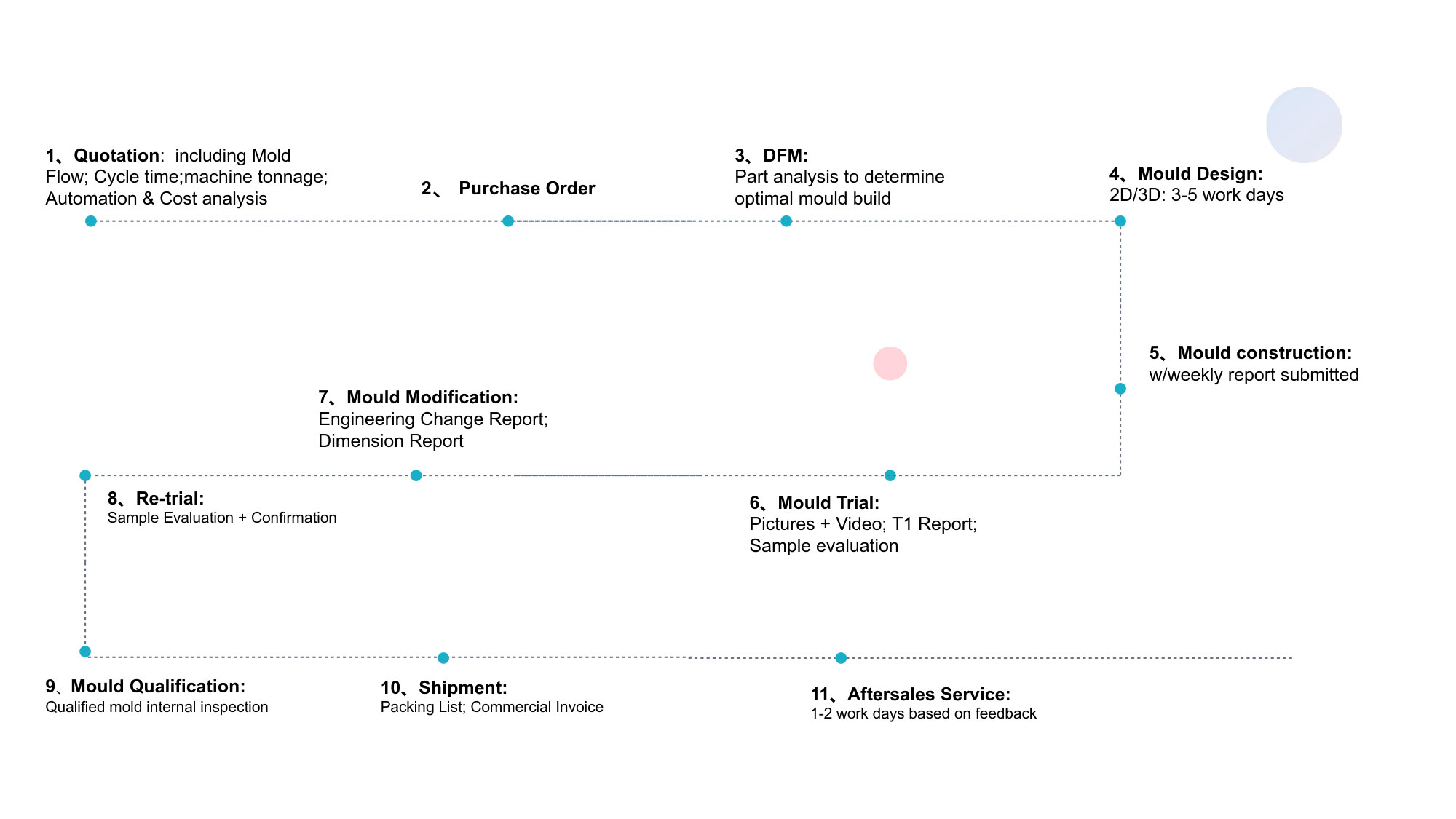
T0–T3 Sample Iterations
We deliver sample shots at each major development milestone:
Stage Description Customer Benefit
T0 First mold trial – preliminary parts Visual confirmation of basic function
T1 Adjusted parameters after T0 Dimensional and surface quality improvements
T2 Fine-tuned process near production target Pre-validation of full production parameters
T3 Final optimized samples with full CPK reporting Ready for customer qualification and approval
We document every trial with a complete improvement report – what changed, why we changed it, and what results were achieved. For molds requiring design revisions, we can swap replaceable mold inserts (rather than rebuilding entire tool) to test different geometries.
Pilot Run (Small-Batch Pre-Production)
Before committing to full-volume production, we can provide 100 to 500 pilot-run parts from optimized production parameters – not just pre-production samples.
Documentation Provided:
First-article inspection report for all dimensions
Process capability (CPK) analysis for critical-to-function dimensions
Visual quality rating across all parts
Cycle time and theoretical daily capacity
Customer value: Customers validate performance and assembly fit with actual production parts before authorizing full-scale runs. This eliminates “first production batch surprise” and allows customers to align inventory planning with proven output capacity.
Tooling Maintenance and Spare Parts
Every mold we deliver includes a recommended set of spare components:
Standard spare ejector pins (common wear items)
Critical core inserts (single or multi-cavity)
Spare guide bushings and wear plates
Maintenance Schedule: We provide a written maintenance guide that specifies lubrication intervals, cleaning protocols, and recommended inspection points every 200,000 shots.
After-Sales Support: For molds requiring service beyond routine maintenance, we perform repairs at cost – no hidden surcharge. The mold owner owns the asset; we simply help keep it operating.
Section Five: Differentiated Responses to Common Customer Pain Points
Rather than abstract claims of technical excellence, we address the specific complaints customers frequently express about other suppliers:
Customer Complaint Ansix Tech’s Guaranteed Response (backed by documented capability)
“The mold keeps needing repairs – production stops too often.” Response: We perform 2,000-shot mold aging test before mold shipment, complete with wear report documenting any dimensional changes. We then provide a three-year mold structure warranty (excluding normal consumable wear items like ejector pins).
“Excessive flash on parts – my assembly line spends hours trimming every batch.” Response: We machine parting lines to 0.005mm shut-off accuracy and employ servo-controlled clamp force compensation. Result: Flash controlled to ≤0.03mm across all batches – eliminating manual deflashing for most applications.
“Part dimensions vary from batch to batch – I can’t rely on just-in-time inventory.” Response: Our machines are equipped with in-mold pressure and temperature sensors providing closed-loop feedback to adjust packing pressure in real-time. For one gasket customer, this reduced dimensional variation from ±0.07mm to ±0.015mm across three consecutive months of production.
“Lead time on mold repairs is too long – I lose weeks when something breaks.” Response: Ansix operates an in-house electrode production and EDM workshop. Mold modifications and repairs rarely leave our facility. Standard repairs (weld repair and insert replacement) restore production within 24 hours of diagnosis.
Our Philosophy: A Mold Is Not a Piece of Steel – It Is a Money-Printing Machine
When we design a mold for your LSR gasket, we simultaneously plan for:
Manufacturability – Runner geometry that fills completely without air entrapment
Maintainability – Cooling channels positioned for easy cleaning and scaling prevention
Longevity – Wear-resistant steel selections at injection points and sliding interfaces
Consistent output – Thermal balance designed so every cavity produces identical parts
Our goal: The mold arrives at your production floor requiring no extended debugging, minimal flash management, and consistent performance across its entire service life.
How Ansix Tech Reduces Customer Costs Across the Value Chain
Material Cost Optimization
Cold runner systems eliminate 15–30% of material waste compared to cold runner/multi-drop systems
Cavity-specific optimization reduces per-part shot weight without compromising fill quality
Bulk purchasing of standard LSR grades (Wacker, Dow, Momentive, Shin-Etsu) passes volume discounts to customers
Manufacturing Efficiency
24/7 automated production capability for high-volume programs
Multi-cavity and family molds reduce per-part cycle time by 60–80% compared to single-cavity tooling
Real-time process monitoring identifies drift before parts go out of spec – preventing scrap accumulation
Quality Assurance Savings
In-line vision inspection catches defects immediately – no off-line sorting costs
CPK≥1.33 on critical dimensions reduces or eliminates customer incoming inspection
Traceable batch records enable targeted root-cause analysis when issues occur – no “stop-all-production” responses
Faster Time-to-Market
DFM review identifies design issues before mold build – no tooling rework delays
In-house electrode and machining capacity for repair inserts – no external lead time
Pilot runs allow process refinement without tying up customer production schedules
Case Example – Real-World Savings:
For an automotive sealing gasket program requiring 2.5 million parts annually, Ansix Tech designed a 32-cavity cold runner mold that:
Reduced per-part material consumption by 22% compared to the customer’s previous single-cavity cold sprue tool
Achieved a 14-second full cycle time – producing 8,200 parts per hour from one machine
Delivered mold with 100% cavities producing within ±0.01mm of nominal, eliminating customer sorting operations
Total estimated annual cost savings for the customer:87,000inmaterial+42,000 in labor/sorting + 31,000inreducedmachinetime=∗∗160,000 annually
Ansix Tech’s 28+ Years of LSR Experience – Reliability You Can Count On
Since our founding in 1998, Ansix Tech has grown from a Hong Kong-based tooling shop to a global manufacturing partner with:
Four production bases across China and Vietnam
260 injection molding machines covering 30-ton to 2800-ton clamping forces
1200+ skilled employees including dedicated process engineers, mold designers, quality specialists, and production technicians
ISO 9001, IATF 16949, ISO 13485, ISO 14001, BSCI certifications
ISO 8 Cleanroom for medical and controlled-environment production
Our experience spans:
Medical LSR – Surgical instrument seals, fluid-path components, catheter gaskets, trocar incision protective covers
Automotive LSR – Under-hood connector seals, battery pack gaskets, fluid sealing profiles for pumps and sensors
Consumer Electronics LSR – Waterproofing gaskets for smartphones, wearables, and outdoor electronics
Industrial LSR – Pneumatic seals, vibration-damping gaskets, and chemical-resistant sealing components
We bring this cross-industry knowledge to every new project – applying automotive precision standards to medical components and medical validation rigor to industrial gaskets when appropriate.
Summary: Why Ansix Tech for Your LSR Gasket Project
Customer Need Ansix Tech Solution
Lower part cost Cold runner systems reduce material waste. Family molds multiply output per machine hour. 260-machine fleet matches tooling to optimal equipment.
Consistent quality In-mold pressure sensors + closed-loop process control + in-line vision inspection + CMM verification at every stage.
Shorter lead times In-house mold design, electrode machining, and EDM capacity – no external dependencies. Standard molds 10–60 days.
Lower project risk DFM analysis before quoting. T0–T3 sample iterations. Pilot runs before full production. Three-year mold structure warranty.
Regulatory compliance ISO 9001/13485/IATF 16949 + ISO 8 cleanroom + FDA (via 510K equivalency) – suitable for medical, automotive, and electronic applications.
Our invitation to you:
We understand that selecting a custom LSR gasket manufacturing partner involves technical scrutiny, commercial evaluation, and trust. We invite you to bring us an existing part or a new design for a full DFM report walkthrough. We will show you – using your geometry – how we would predict and prevent weld lines, air traps, shrinkage issues, and flash risks before the first tooling dollar is spent.
Ansix Tech does not just make molds. We engineer reliable production systems that turn liquid silicone rubber into consistently high-quality gaskets – on time, on budget, and without quality surprises.
Contact us to begin the conversation. Let’s put our experience to work for you.
Ansix Tech Co Ltd
If you have any plans related to LSR Liquid Silicone Gasket , you can contact us at any time. We will turn your ideas into reality, let you realize your dreams, and obtain large orders from the market. Our contact information is info@ansixtech.com. Or contact our CTO, mail: stephen@ansixtech.com
#www.ansixtech.com #ansixtech.com #LSR Liquid Silicone Gasket #LSR Liquid Silicone Gasket injection molding companies #LSR Liquid Silicone Gasket Canopy Mold injection mold companies #Ansix #Ansix moulds #Ansix china #Ansix tech china #Ansix tech company #Ansix facotry #LSR Liquid Silicone Gasket injection molding #LSR Liquid Silicone Gasket injection tools #LSR Liquid Silicone Gasket injection moulds #LSR Liquid Silicone Gasket plastic mould #LSR Liquid Silicone Gasket plastic tools #Ansix Tech #Ansix molds #Ansix injection molding #Ansix mold factory #injection molding LSR Liquid Silicone Gasket#Ansix mold factory #LSR Liquid Silicone Gasket china #LSR Liquid Silicone Gasket molds #injection factory #LSR Liquid Silicone Gasket injection molding #LSR Liquid Silicone Gasket injection molding factory #injection molding company #LSR Liquid Silicone Gasket injection mold companies #LSR Liquid Silicone Gasket Tooling #LSR Liquid Silicone Gasket mold limited #Ansix mold china #Ansix companies #Ansix company China #LSR Liquid Silicone Gasket facotry #Ansix Tech #Ansix Tech mould #LSR Liquid Silicone Gasket injection moulding #injection moulding company #Ansix LSR Liquid Silicone Gasket parts injection mold companies #medical injection molding companieschina #LSR Liquid Silicone Gasket china factory #Ansix moulding companies #Ansix molding company #LSR Liquid Silicone Gasket injection moulding facotry #Ansix Tech mold #LSR Liquid Silicone Gasket mould #LSR Liquid Silicone Gasket plastic injection molding #ansix plastic mold #Mold manufacturing #LSR Liquid Silicone Gasket parts manufacturing #LSR Liquid Silicone Gasket plastic parts factory #LSR Liquid Silicone Gasket injection parts mold #LSR Liquid Silicone Gasket PRECISION MANUFACTURING #LSR Liquid Silicone Gasket #China mold #LSR Liquid Silicone Gasket injection moulding china #LSR Liquid Silicone Gasket mould china #china precision mold #mold in china #LSR Liquid Silicone Gasket mold china #Precision molds #High-precision molds #LSR Liquid Silicone Gasket #Injection molds #LSR Liquid Silicone Gasket Factory #LSR Liquid Silicone Gasket Company #Super Large Injection Mold Factory #Large Tonnage Injection Molding Factory #LSR Liquid Silicone Gasket Company #LSR Liquid Silicone Gasket Factory #2800T Injection Molding Factory #3000 Ton Injection Molding #4500 Ton Injection Molding Factory #Large Mold Injection Molding #Large Plastic Mold Injection Molding Factory #Large Injection Mold Manufacturer #Plastic Mold Factory #Injection Mold #Plastic Mold