



LSR liquid silicone-coated connector sealing ring
FEATURES
Product Overview — What We Deliver and Why It Matters
What Is an LSR Liquid Silicone-Coated Connector Sealing Ring?
An LSR liquid silicone-coated connector sealing ring is a precision-engineered elastomeric component integrated into electrical connectors to provide waterproof, dustproof, and pressure-tight sealing. These rings are either fully molded from liquid silicone rubber or overmolded onto metal or plastic connector housings, creating a permanent chemical bond that ensures IP67/IP68-rated protection across the service life of vehicles, electronics, and industrial equipment.
-
Mold Description
Product Materials:
LSR silicone
Soft rubber: silicone
Mold Material:
S136ESR
Number of Cavities:
8
Glue Feeding Method:
Hot runner
Cooling Method:
Water cooling
Molding Cycle
22.5s
- The mold manufacturing process and product material selection
Why Customers Choose LSR for Connector Sealing Rings
Customer Benefit Technical Enabler Business Impact
Lifetime reliability Platinum-cured LSR resists UV, ozone, extreme temperatures (-50°C to 230°C) Lower warranty costs
Consistent sealing force Low compression set (<10%) maintains seal integrity No field failures from lost spring-back
Easy assembly Self-lubricating formulations (1% oil-filled, e.g., SILASTIC™ 9201-50) Faster production, fewer damaged connectors
IP67/IP68 compliance Precision molding with controlled parting lines <0.03mm flash Meets automotive/industrial certification requirements
Primerless adhesion Advanced materials like Silopren™ LIM9071 ET bond directly to metals and engineering plastics Eliminates adhesive curing time, reduces assembly steps
LSR offers the combination of high thermal stability, ozone and UV resistance, and long-term, non-aging mechanical properties required to maintain dependable performance under the most challenging environmental conditions.
-
The Connector Landscape We Serve
Peripheral (ring) seals — seals around the housing-to-housing interface
Single-wire seals (cavity plugs) — seals individual conductor entries
Mat seals (end seals/grommets) — multi-cavity seals for wire harness connectors
FAKRA and high-speed data connector seals — sealing for automotive coaxial and high-frequency data connections
Overmolded sealed connectors — LSR molded directly onto connector housings, eliminating separate seal installation
Part Two: The “Hard Power” Foundation — Equipment Infrastructure That Builds Trust
Customers trust manufacturers with proven equipment. Our technology base is not merely a list of machines — it is a system engineered for precision, consistency, and scale.
2.1 Mold Manufacturing Equipment
Equipment Type Specification Customer Value Delivered
5-axis high-speed machining centers Machining precision to 0.002mm on complex curved surfaces Smooth, flash-free parting lines — no secondary trimming required
Slow-moving wire EDM Capable of cutting 0.03mm micro-apertures and narrow slots Enables thin-wall designs without structural deformation
High-speed CNC machining ±0.005mm positioning accuracy Consistent cavity dimensions across multi-cavity molds
Electrical discharge machining (EDM) In-house electrode machining center Mold repairs stay on-site — 24-hour turnaround on modifications
With 5-axis CNC capabilities, we can machine complex parting lines with precision that ensures the mold closes perfectly every time, eliminating the rough edges that cause customer assembly jams and secondary deburring costs.
How This Saves You Money: Every 0.01mm of flash that you do not have to manually remove represents a direct labor savings. Our precision machining eliminates up to 15 seconds of post-processing per part — on 500,000 parts, that is over 2,000 hours of saved labor.
2.2 Injection Molding Machine Fleet
Parameter Coverage Customer Value
Clamping force range 30 tons to 4000 tons Sealing rings from 2mm diameter to 500mm peripheral seals
Drive system All-servo motor driven ±0.1% repeatable shot-to-shot consistency
Process control Closed-loop pressure/velocity control Every shot mirrors the first — batch-to-batch dimensional stability
Automated demolding Integrated pick-and-place robotics Reduced operator dependency, 24/7 production capability
The value proposition is simple: when we promise every part meets your specification, we can deliver because our machines hold parameters tighter than your tolerance requirement.
2.3 Quality Inspection Equipment
Equipment Capability Customer Value
CMM (Coordinate Measuring Machine) Full dimensional reporting on every mold before shipment You receive a mold that works the first time — no trial-and-error debugging
Optical vision measurement system 0.001mm resolution Key dimensions verified with CPK ≥ 1.33
Hardness tester Shore A measurement per ASTM D2240 Confirms full cure and consistent material properties
Tensile/tear testing ASTM D412 / D624 compliance Validates mechanical integrity under real-world conditions
Our Commitment: Every mold we deliver ships with a full dimensional inspection report. We deliver certainty, not surprises.
Part Three: Mold Manufacturing — The Core Competency
The mold is not a piece of steel — it is your production asset, your quality assurance, and your profit engine. Ansix Tech treats every LSR mold as a long-term investment that must deliver predictable output, minimal maintenance, and maximum uptime.
3.1 Mold Life Expectancy — A Quantified Promise
Material Type Guaranteed Mold Life What This Means for You
Glass-fiber reinforced materials 500,000 shots minimum Your mold stays productive for years of high-volume production
Unfilled LSR / engineering plastics 1,000,000 shots minimum One mold — one program — no mid-life surprises
We back this guarantee with documented steel material certifications and heat treatment curves, provided with every quotation.
3.2 Achievable Tolerances — Spec-Driven Confidence
Component Type Achievable Tolerance Application
Conventional structural parts ±0.05mm Most connector sealing applications
Precision sealing lips / thin walls ±0.02mm Critical sealing interfaces
High-precision custom requirements ±0.005mm (upon request) Medical, aerospace, or ultra-precision applications
3.3 Mold Steel Selection Guide
Our material selection is driven by your production volume, part geometry, and performance requirements. We provide documented traceability and material certifications.
Steel Grade Properties Best Application
S136 / S136H (Stavax) High corrosion resistance, mirror polish capability (Ra ≤ 0.1μm) High-transparency LSR products, medical/food-grade parts
420 stainless steel Excellent corrosion resistance Long-term contact with LSR, high-humidity environments
NAK80 Pre-hardened (HRC 38-41), no heat treatment required, good machinability Large molds requiring dimensional stability and good polish
H13 (2344/8407) High hot hardness, thermal fatigue resistance High-temperature LSR molding, glass-filled materials
718H Hardness HRC 30-35, cost-effective High-volume production mold bases
SKD11 / DC53 High wear resistance, good toughness High-cycle molds, abrasive LSR formulations
M340 / 4Cr13 / 9Cr18 Superior corrosion resistance Medical, pharmaceutical, and food-contact applications
ELMAX Powder metallurgy steel, extreme wear and corrosion resistance High-performance applications, glass-filled materials
Surface treatments for enhanced performance:
Hard chrome plating (5-10μm thickness): Reduces surface friction (μ ≤ 0.1), extends mold life
PTFE coating (2-3μm thickness): Reduces demolding force by up to 30% — prevents part sticking and tearing
DLC (Diamond-Like Carbon coating): For optical-grade surfaces requiring superior release properties
3.4 Runner System Strategy — Material Efficiency as a Competitive Advantage
LSR material costs are significant — 30-80% of raw material savings directly impact your bottom line. We optimize runner systems based on your production volume.
Runner Type Best For Material Savings Production Efficiency
Fully cold runner system High-volume production 30-80% material saved — no runner scrap Flow channels cooled to 15-20°C, material remains liquid for next shot
Needle-valve cold runner Precision small parts 100% material utilization — absolutely no waste Independently controlled injection timing, no flash, no stringing
Hot runner system Very high-volume, complex geometries Eliminates runner scrap entirely Faster cycles, shorter cure times, consistent temperature profile
How This Saves You Money: With LSR as a premium material, runner waste for small sealing rings can be up to five times the weight of the part itself. By eliminating runner waste entirely, we convert what would be scrap into finished goods — delivering 20-40% material cost savings on every production run.
3.5 Mold Flow Analysis (DFM) — Solving Problems Before Steel Is Cut
Every Ansix Tech LSR mold project begins with Design for Manufacturability (DFM) review and comprehensive mold flow simulation using advanced CAE software. This investment pays dividends by eliminating costly downstream revisions.
What Mold Flow Analysis Identifies and Solves:
Potential Defect Root Cause Our Preemptive Solution
Weld lines (fusion marks) Improper gate location causing flow-front convergence Gate repositioning and flow balancing optimized before tooling
Air traps / voids Material flows around core pins, trapping air Vent placement optimized, vacuum assist designed in
Incomplete fill (short shots) Flow imbalance or insufficient injection pressure Runner balance, gate sizing, and pressure profiles optimized
Parting line flash Inadequate clamp force or parting surface mismatch 0.005mm parting surface flatness specification
Uneven cure Temperature gradient across cavity Mold heating channel design optimized for ≤2°C temperature variation
Why This Saves You Time and Money: Upfront DFM and mold flow analysis identify manufacturability issues before tooling begins, reducing redesign cycles and launch risk while lowering tooling, scrap, and production costs. For our LSR connector sealing ring projects, proactive simulation typically reduces T0-to-production cycles from 5+ iterations to just 1-2 trial runs, cutting 3-4 weeks from the development timeline.
3.6 Mold Cooling and Heating System Design
LSR requires mold temperatures between 150-180°C to achieve full crosslinking cure, yet the runner system must remain cool (20-40°C) to prevent premature curing. This thermal dichotomy demands sophisticated design.
Our Cooling/Heating Design Standards:
Zone-controlled heaters: Individual cartridge heaters for mold cavities, maintaining ±2°C across all cavities
Spiral cooling channels: Optimized water channels within the cold runner plate ensure rapid, even cooling
Thermal barrier design: Insulation layers between heated cavity zones and cooled runner zones prevent heat transfer
Thermocouple monitoring: Real-time temperature feedback with machine controllers enabling closed-loop adjustment
3.7 Parting Line and Venting Design
The parting line of an LSR mold is simultaneously a sealing surface (preventing leakage) and a venting path (allowing trapped air to escape).
Our Quality Commitments:
Parting surface flatness: ≤0.005mm (CMM-verified)
Closure gap: ≤0.01mm — no material escape, no flash generation
Vent depth: 0.01-0.03mm precision-ground vents at fill endpoints, core pin junctions, and ejector pin locations
Complex geometry parts: Vacuum-assist venting system integrated into mold design
3.8 Ejector System Design
LSR is inherently tacky and resilient — ejector systems must be designed to release parts without stretching, tearing, or leaving visible marks.
Our Design Approach:
Angled ejector pins positioned away from cosmetic surfaces whenever possible
Air-assisted ejection for thin or delicate sealing lips
Stripper plate ejection for ring-shaped parts — uniform force distribution prevents distortion
Ejector pin location and mark size agreed with customers during DFM review
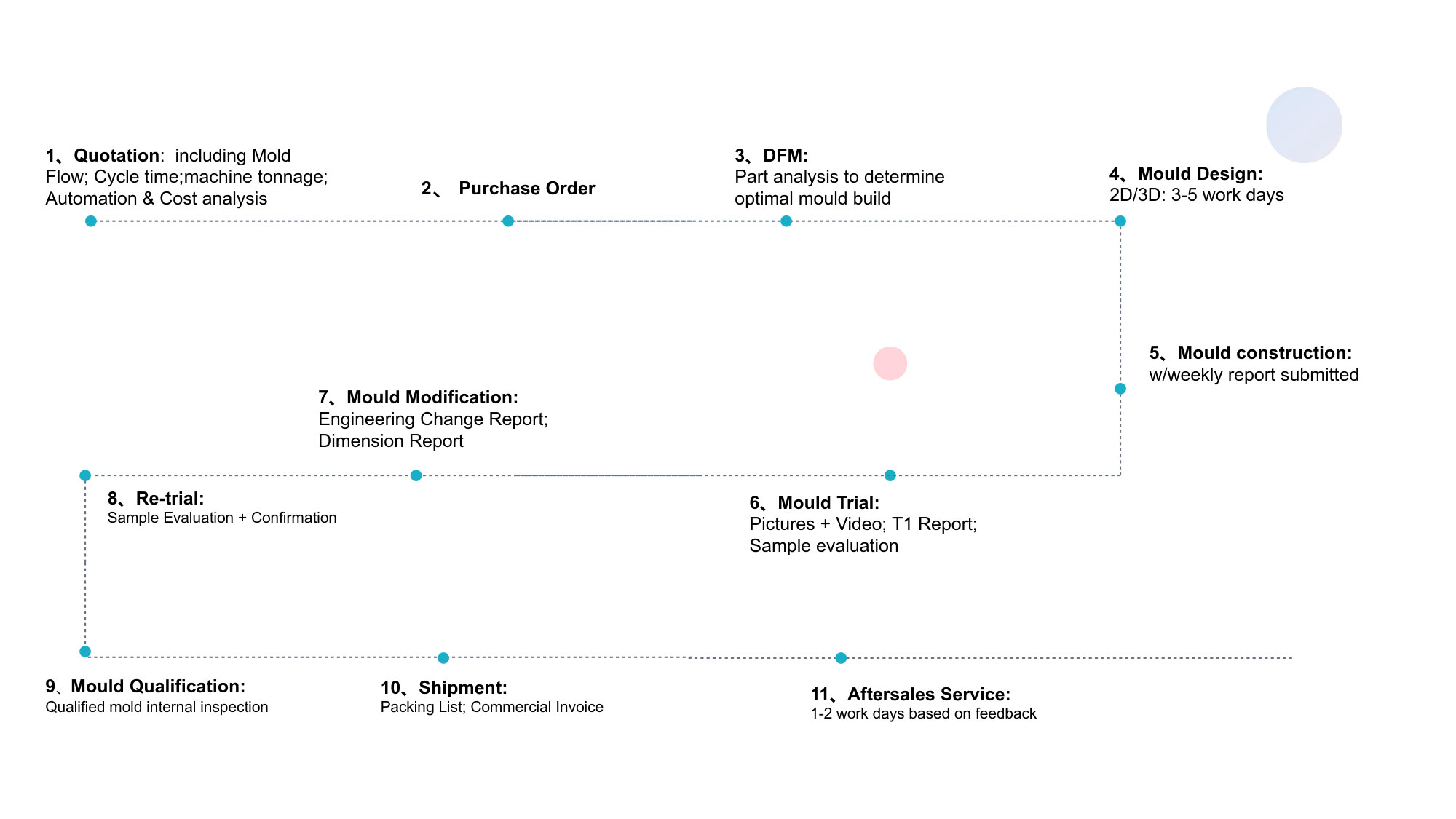
3.9 Mold Manufacturing Process Flow
Our in-house mold manufacturing capability ensures quality control and rapid turnaround:
Engineering Design: 3D modeling + DFM review + mold flow analysis
Material ordering: Steel certificates with full traceability
CNC roughing: ±0.2mm allowance for final finishing
Heat treatment: Quenching and tempering to target HRC spec
Precision grinding: Surface and profile grinding to final dimensions
High-speed CNC finishing: Final precision cuts, typical tolerance ±0.005mm
EDM processing: Micro-features, sharp corners, and cooling channels
Hand polishing: Mirror-finish cavity surfaces (Ra ≤ 0.025μm for high-gloss products)
Mold assembly: All components fitted, ejector systems verified for smooth operation
First trials (T0-T3): Iterative optimization based on trial samples and adjustment reports
3.10 Standard Lead Times
Mold Complexity Standard Lead Time Express Lead Time
Simple single-cavity mold 10-15 days 7-10 days
Medium-complexity multi-cavity mold 25-35 days 18-22 days
Complex high-cavitation cold runner mold 35-45 days 25-30 days
Important Note: Even with expedited timelines, we never skip validation steps. Every express delivery project undergoes full QA verification — you receive quality, not shortcuts.
Part Four: LSR Injection Molding — Process Control That Reduces Customer Quality Anxiety
Customers worry about shrinkage, flash, dimensional inconsistency, and batch-to-batch variation. Our LSR injection molding process controls are engineered to eliminate these concerns entirely.
4.1 Process Standardization and Traceability
MES-integrated machine network: All process parameters (temperature, pressure, injection speed, curing time) locked in the manufacturing execution system
Change control: Only authorized engineers can modify parameters, with full audit trail
First-article and last-article inspection: Every production batch verified against master samples
Statistical process control: Key dimensions charted with real-time CPK monitoring
4.2 Dimensional Stability Control — Eliminating “Every Batch Looks Different”
Our Approach:
Zone-controlled mold heaters maintain cavity-to-core temperature variation ≤2°C, preventing warpage and shrinkage inconsistencies
Ultrasonic wall thickness sensors provide real-time feedback, enabling automatic compensation of packing pressure
Mold-mounted temperature and pressure sensors enable closed-loop process control
Real-world performance: For a typical connector sealing ring, three production batches run one week apart showed critical seal lip diameter variation ≤0.02mm
4.3 Shrinkage Compensation
LSR shrinks during cure — typical volumetric shrinkage of 2.5-3.5%. We calculate and pre-compensate shrinkage in cavity design and verify through T0-T3 trial iterations, ensuring finished parts conform to your nominal dimensions.
4.4 Appearance Quality Grades
Quality Level Achievable Surface Mold Finish Requirement
Standard industrial Functional surface, no flash, no gross defects Standard polished (Ra 0.2-0.4μm)
High-cosmetic No visible flow marks, no pits High polish (Ra ≤ 0.1μm)
Optical / transparent Bubble-free, streak-free, no visible defects Mirror polish (Ra ≤ 0.025μm), DLC-coated cavities
4.5 Material Processing Capabilities — Experience That Counts
Ansix Tech has extensive processing experience with a wide range of LSR and high-performance thermoplastic materials:
LSR (all Shore A hardnesses from 10 to 80): Self-lubricating grades, fast-cure grades, primerless adhesion grades, UL94 V-0 flame-retardant grades
Engineering thermoplastics for hybrid molding: PC/ABS, PC, PPS+40%GF, PEEK, PTFE/PFA, PA6+GF30, PBT, PEI, LCP
Fluorosilicone (F-LSR): For solvent and chemical resistance
Certified Material Attributes:
UL94 V-0 flame rating for connector housings in electrical applications
UV resistance tested to 3,000 hours without yellowing (f1 outdoor rating per UL 746C)
Biocompatible grades for medical applications — tasteless, odorless, mold- and bacteria-resistant
Platinum cure systems: No residual by-products, low VOC, superior thermal and chemical stability
4.6 Overmolding and Insert Molding Capability
For connector sealing rings that must bond directly to metal terminals or plastic housings:
Primerless adhesion LSR grades (Silopren™ LIM9071 ET, LIM 8040) achieve maximum adhesion immediately after demolding
Strong chemical bonding between LSR and metal inserts through optimized surface preparation and high-flow LSR formulation
Permanent adhesion ensures seals do not shift (“roll-over”) during assembly — superior performance with fewer steps
4.7 Defect Prevention — Solutions to Common Industry Complaints
Common Customer Complaint Our Technical Response Quantified Benefit
“Molds need constant repair, delaying orders” Pre-delivery 2,000-shot aging test with wear report; three-year structure warranty (excluding normal wear) No mid-program downtime surprises
“Excessive flash — high post-processing costs” 0.005mm parting surface precision; self-locking clamp force compensation; flash ≤0.03mm Eliminates manual deflashing
“Dimensions vary from batch to batch” In-mold pressure/temperature sensors with closed-loop control; real-time CPK monitoring Batch-to-batch variation ≤0.02mm
“Mold repairs take too long” In-house electrode CNC + EDM workshop; standard repairs 24 hours turnaround Days, not weeks, for mold maintenance
4.8 Curing Cycle Optimization — Your Production Output Per Shift
LSR cures at 150-190°C in 20-60 seconds per shot, depending on part geometry and material grade. Our optimization strategies accelerate this:
Multi-cavity molds with optimized runner balance enable higher output per cycle
Fast-cure LSR formulations reduce cure time by 20-40% for the same mechanical properties
Precision temperature control ensures complete cure in minimal time
Automated demolding — parts removed and conveyed without operator intervention
In one example, an 8-cavity LSR sealing ring mold running at 55-second cycle time produces eight parts weighing 0.8 grams each per cycle — approximately 523 parts per hour per machine.
Part Five: End-to-End Service — Reducing Customer Management Cost
Many mold suppliers deliver steel; Ansix Tech delivers a complete production solution that minimizes your management burden.
5.1 Early Engagement — DFM Report Before You Commit
Before we cut any steel, we provide a comprehensive mold feasibility analysis including:
Material shrinkage projection and cavity compensation
Draft angle recommendations (inner surfaces 3-5°, outer surfaces 1-3°)
Wall thickness optimization for balanced flow and structural integrity
Recommended gate and ejector pin locations with mark position allowances
Risk assessment for undercuts, sink marks, and thin-wall sections
Why This Reduces Your Risk: You receive a “build-ability” assessment before tooling investment — no surprises after the mold is committed.
5.2 Trial Shot Deliverables — Transparency Every Step
From T0 (first trial) through T3 (production-ready validation), we deliver:
Physical sample parts with full dimensional inspection reports
Detailed adjustment reports explaining modifications made and why
High-resolution images of molded parts showing gate location, parting line, and surface quality
Recommendations for production process optimization
5.3 Low-Volume Pre-production Validation
Before committing to mass production, we offer 100-500 pre-production shots with:
Statistical analysis of yield and CPK data
Validation of packaging, labeling, and traceability requirements
Customer approval of run-at-rate capability
No commitment to mass production until you are satisfied
5.4 Maintenance, Spare Parts, and Ongoing Support
Service Details Cost
Spare parts kit Ejector pins, core inserts, valve needles — shipped with every mold Included in mold price
Preventive maintenance Comprehensive mold service every 200,000 shots Fee-based, cost-recovery only
Lifetime repair All mold repairs processed by our in-house shop Parts at cost, labor at hourly rate
Technical support Phone and email support for any molding issue Included for mold life
Part Six: Cost Leadership — How Ansix Tech Delivers More Value for Less
Our cost advantage is not about cutting corners — it is about engineering efficiency.
6.1 Material Cost Optimization
Strategy Mechanism Typical Savings
Runnerless molding (cold runner) No runner waste — material utilization 100% 30-80% material cost reduction
Precision flash control Flash ≤0.03mm eliminates regrind/trim loss 5-10% material savings
Hot runner for high volume Eliminates runner scrap entirely 15-30% material savings
6.2 Cycle Time Reduction — More Parts Per Hour
Strategy Mechanism Typical Impact
Fast-cure LSR formulations Reduced cure time from 60 seconds to 30-40 seconds 30-50% higher output per machine hour
Optimized cooling circuit Even, rapid cooling reduces cycle time 10-20% cycle reduction
Automated demolding No operator waiting time 15-25% uptime improvement
Stack / multi-cavity molds Double the output per cycle 100% capacity increase for same footprint
6.3 Tooling Cost Management
Multi-cavity design spreads tooling cost across higher output volumes
Modular insert design — replace damaged inserts without rebuilding whole mold
Flexible family molds — produce multiple part variants with same base frame
Upfront DFM reduces tooling revisions — 1-2 trial cycles vs. industry average of 4-5
6.4 Reduction in Total Cost of Ownership
Cost Element Conventional Approach Ansix Tech Approach
Mold cost Low initial cost — high maintenance cost Higher-quality steel, precise machining — lower maintenance
Material cost Paying for runner waste Runnerless or minimized runner — savings up to 80%
Labor cost Manual deflashing and inspection ≤0.03mm flash — no secondary finishing
Quality cost Production variations — scrap and rework CPK ≥ 1.33 — consistent parts, minimal scrap
Logistics cost Multiple supply chain handoffs One supplier for mold + molding — lower management overhead
6.5 Verified Cost Savings — Real-World Data
Case: Small wire seal — One customer achieved 28% overall part cost reduction through runnerless molding and cycle time optimization
Case: High-volume peripheral seal — Multi-cavity mold with 30% faster cycle time enabled higher per-shift output, offsetting higher tooling investment within six months
Part Seven: Customer Value Summary — What Ansix Tech Actually Delivers
Your Concern What We Deliver Measurable Benefit
Mold too expensive Optimal mold design — multi-cavity, modular, cold runner Lower per-part tooling amortization
Long tooling lead time 10-45 day mold delivery, in-house machining Fastest time-to-market
Quality problems DFM upfront, mold flow analysis, CPK monitoring Parts that work — first time, every time
Production delays In-house maintenance, spare parts kit, 24-hour repairs No unexpected downtime
Hard to manage One supplier: design, mold, molding, assembly Lower procurement and vendor management cost
Limited capacity 30-4000T machine fleet, 24/7 automated operation Scalability for peak demand
No product design support Early DFM review, CAE mold flow analysis No “surprises” after mold is built
Conclusion: A Mold Is Not a Block of Steel — It Is Your Profit Machine
At Ansix Tech, our design philosophy is simple: we do not just cut metal — we engineer reliable production platforms.
Every LSR mold we deliver comes with:
Pre-calibrated steel shrinkage compensation
Optimized temperature balance across every cavity
Precision-ground venting and sealing surfaces
Runner efficiency that saves your material budget
Ejector systems that release clean parts without damage
The result for you: molds that are essentially “plug-and-play” on your production line — minimal debugging, low flash generation, and maximum service life.
With 28 years of LSR molding experience, full in-house mold manufacturing, and a proven track record in automotive, electronics, medical, and industrial connector sealing applications, Ansix Tech is your trusted partner for LSR liquid silicone-coated connector sealing rings.
Let us make you a proposal. We will walk you through a DFM analysis for one of your current connector sealing ring designs, and you will see exactly how we eliminate weld lines, air traps, shrinkage, and flash — saving you time, material, and budget.
Ansix Tech Co Ltd
If you have any plans related to LSR liquid silicone-coated connector sealing ring , you can contact us at any time. We will turn your ideas into reality, let you realize your dreams, and obtain large orders from the market. Our contact information is info@ansixtech.com. Or contact our CTO, mail: stephen@ansixtech.com
#www.ansixtech.com #ansixtech.com #LSR liquid silicone-coated connector sealing ring #LSR liquid silicone-coated connector sealing ring injection molding companies #LSR liquid silicone-coated connector sealing ring Canopy Mold injection mold companies #Ansix #Ansix moulds #Ansix china #Ansix tech china #Ansix tech company #Ansix facotry #LSR liquid silicone-coated connector sealing ring injection molding #LSR liquid silicone-coated connector sealing ring injection tools #LSR liquid silicone-coated connector sealing ring injection moulds #LSR liquid silicone-coated connector sealing ring plastic mould #LSR liquid silicone-coated connector sealing ring plastic tools #Ansix Tech #Ansix molds #Ansix injection molding #Ansix mold factory #injection molding LSR liquid silicone-coated connector sealing ring#Ansix mold factory #LSR liquid silicone-coated connector sealing ring china #LSR liquid silicone-coated connector sealing ring molds #injection factory #LSR liquid silicone-coated connector sealing ring injection molding #LSR liquid silicone-coated connector sealing ring injection molding factory #injection molding company #LSR liquid silicone-coated connector sealing ring injection mold companies #LSR liquid silicone-coated connector sealing ring Tooling #LSR liquid silicone-coated connector sealing ring mold limited #Ansix mold china #Ansix companies #Ansix company China #LSR liquid silicone-coated connector sealing ring facotry #Ansix Tech #Ansix Tech mould #LSR liquid silicone-coated connector sealing ring injection moulding #injection moulding company #Ansix LSR liquid silicone-coated connector sealing ring parts injection mold companies #medical injection molding companieschina #LSR liquid silicone-coated connector sealing ring china factory #Ansix moulding companies #Ansix molding company #LSR liquid silicone-coated connector sealing ring injection moulding facotry #Ansix Tech mold #LSR liquid silicone-coated connector sealing ring mould #LSR liquid silicone-coated connector sealing ring plastic injection molding #ansix plastic mold #Mold manufacturing #LSR liquid silicone-coated connector sealing ring parts manufacturing #LSR liquid silicone-coated connector sealing ring plastic parts factory #LSR liquid silicone-coated connector sealing ring injection parts mold #LSR liquid silicone-coated connector sealing ring PRECISION MANUFACTURING #LSR liquid silicone-coated connector sealing ring #China mold #LSR liquid silicone-coated connector sealing ring injection moulding china #LSR liquid silicone-coated connector sealing ring mould china #china precision mold #mold in china #LSR liquid silicone-coated connector sealing ring mold china #Precision molds #High-precision molds #LSR liquid silicone-coated connector sealing ring #Injection molds #LSR liquid silicone-coated connector sealing ring Factory #LSR liquid silicone-coated connector sealing ring Company #Super Large Injection Mold Factory #Large Tonnage Injection Molding Factory #LSR liquid silicone-coated connector sealing ring Company #LSR liquid silicone-coated connector sealing ring Factory #2800T Injection Molding Factory #3000 Ton Injection Molding #4500 Ton Injection Molding Factory #Large Mold Injection Molding #Large Plastic Mold Injection Molding Factory #Large Injection Mold Manufacturer #Plastic Mold Factory #Injection Mold #Plastic Mold