



PPS Card Insert
FEATURES
Molded parts are subjected to thermal cycling (-40°C to 150°C), dielectric strength test, and 3000-hour UV aging on request.
We also provide full material certificates, dimensional reports, and process capability data.
Competitive Cost Control
We lower total cost through three strategies:
Material optimization – Using regrind management and cascade runner systems reduces scrap by up to 18%.
Cycle time reduction – High-efficiency cooling (conformal channels) cuts molding cycles by 22% compared to conventional designs.
Automation – Robotic take-out, conveyor integration, and in-mold labeling eliminate secondary labor.
These measures reduce piece price by 15–30% while maintaining tight tolerances (±0.02mm typical). Customers save tooling amortization costs thanks to our 1-million-shot mold life guarantee (for glass-filled PPS).
By choosing Ansix Tech, you get a PPS Card Insert that combines premium material performance, rapid delivery, zero-defect quality, and lowest landed cost.
-
Mold Description
Product Materials:
PPS
Mold Material:
S136ESR
Number of Cavities:
18
Glue Feeding Method:
COLD runner
Cooling Method:
Water cooling
Molding Cycle
22.5s
PPS Card Insert: Mold Manufacturing, Material Selection, Smart Manufacturing & Process Quality Value (≈500 words)
Mold Manufacturing & Material Selection
For PPS Card Insert molds, material choice directly affects part quality and tool longevity. We select:
Mold base: P20 steel for standard applications, or H13 for high-cycle tools.
Core/Cavity inserts: S136 (stainless, corrosion-resistant) for cleanroom or medical inserts; 2344, 8407, or DC53 for high-wear PPS+GF applications; NAK80 for high gloss and texture transfer.
Wear-resistant details: For micro-ribs (0.3mm width) and narrow slots, we apply powder metallurgy steel (e.g., M340) or coated inserts (TiAlN/CrN).
Each material comes with a certified heat-treatment curve and hardness report (48–52 HRC for cores, 52–56 HRC for cavities in PPS+GF).
-
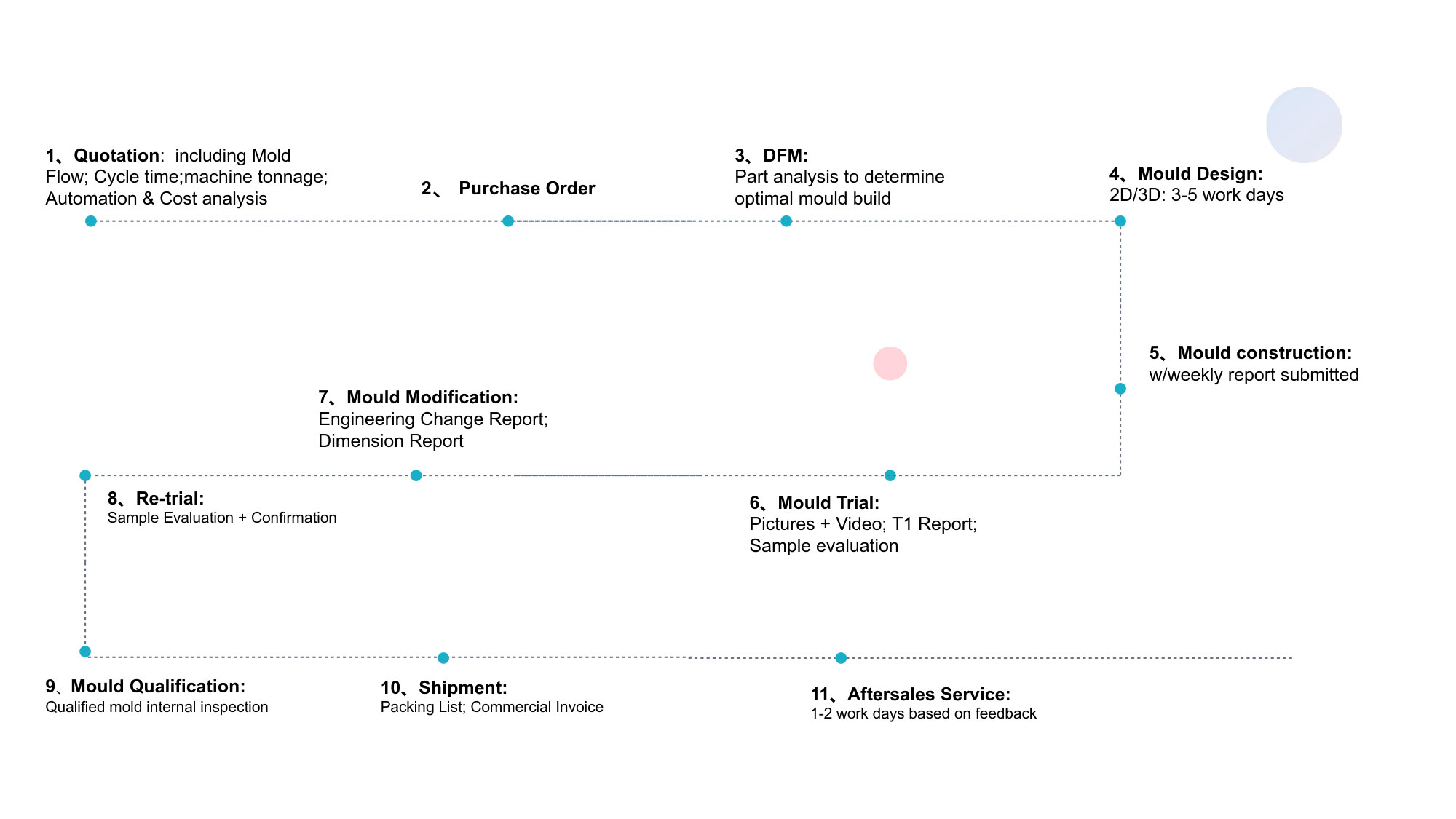
The mold manufacturing process and product material selection
Smart Manufacturing & Efficiency
Ansix Tech integrates Industry 4.0 into mold making and molding. Our mold workshop features:
5-axis high-speed machining (0.002mm positioning accuracy) for complex contours and zero-burr parting lines.
Slow wire EDM capable of 0.03mm micro-holes and narrow grooves without burr or thin-wall deformation.
Robotized electrode changing and automatic tool presetting.
On the molding floor, all injection machines are connected to a MES system that locks temperature, pressure, speed, and time parameters. Only authorized engineers can modify process recipes. Real-time sensors (intra-cavity pressure, nozzle melt temperature) feed data to a cloud SPC dashboard. If any deviation exceeds ±1%, the system automatically adjusts holding pressure or rejects the shot. This reduces human error and boosts overall equipment effectiveness (OEE) to 88%.
Process Quality Assurance – Customer Value
Customers fear dimensional drift, flash, sink marks, and batch-to-batch color variation. Our response:
Flash control: Parting line machined to 0.005mm fit tolerance, plus self-locking clamp force compensation, limits flash to ≤0.03mm – eliminating manual deburring and saving $0.02–0.05 per part.
Dimensional stability: Mold temperature is zoned by independent water manifolds with ΔT ≤2°C between core and cavity. For a typical card insert with four locating holes, hole-to-hole spacing fluctuation ≤0.02mm across three consecutive production weeks.
Visual grades: For opaque PPS (black or natural), we achieve Class A surface (Ra≤0.2μm) with no flow marks. For transparent or laser-markable grades, bubble-free and weld-line-free surfaces are guaranteed.
What customers truly gain
Lower risk: Pre-production DFM and 2000-shot mold test prevent surprises.
Lower cost: Smart automation reduces direct labor by 35%, passed on to you.
Faster time-to-market: Parallel engineering – while mold is being cut, we order raw materials and design gauges.
Reliable supply: Backup molds for high-volume programs ensure zero production interruption.
This integrated approach turns your PPS Card Insert program into a predictable, profitable operation.
Part 3 – PPS Card Insert: Full Manufacturing Solution by Ansix Tech (2000+ words)
Project Initiation – Ansix Tech’s PPS Card Insert Program
With over 28 years of experience in precision injection molding and mold manufacturing, Ansix Tech has established a dedicated PPS Card Insert production cell. Our mission is to transform professional jargon into tangible customer value – solving real problems, reducing costs, mitigating risks, and guaranteeing on-time delivery. This document outlines our complete manufacturing solution, organized into five core sections, each translating technical capabilities into business benefits for you.
Section 1 – Hard Power Foundation: Equipment That Builds Trust
Customers often ask: “Can you really hold tight tolerances on glass-filled PPS? How consistent is your mass production?” Our equipment answers these questions.
Mold Machining Center
We operate a fleet of 5-axis high-speed machining centers (Röders and GF Machining Solutions) with 0.002 mm linear resolution and 0.0005° angular accuracy. This allows us to machine complex 3D contours, such as card insert pockets with 0.1 mm ribs and 0.5° draft angles, without visible step lines.
Customer value: No post-polishing on parting lines → zero flash → lower deburring cost.
Risk reduction: Precise electrode machining ensures repeatable EDM gaps for micro-slots (0.03 mm width) without thin-wall deformation.
Slow Wire EDM (Charmilles & Sodick)
We use oil-jet and submerged wire EDM capable of cutting 0.03 mm narrow slots and intricate core pins. For PPS Card Inserts that require anti-static tracks or snap-fit undercuts (≤0.2 mm thickness), this technology prevents burrs and maintains edge sharpness.
Customer benefit: You save on secondary cleaning operations – parts come off the mold ready to assemble.
Injection Molding Presses – Full Electric Servo
Our molding hall contains 36 presses ranging from 30 to 4000 tons clamp force, covering card inserts as small as 10×15 mm up to structural covers of 300×400 mm. All machines are Sumitomo, Fanuc, or Engel with all-electric servo drives.
Repeatability: ±0.1% injection speed and pressure repeatability, meaning the 10,000th part is identical to the first.
Energy efficiency: 40% less power consumption than hydraulic machines – savings we share through lower piece pricing.
Inspection & Metrology
We deploy a Zeiss CMM (accuracy ±1.5 μm), Keyence optical comparator, and 3D optical scanner for full-surface mapping. Every mold and each batch of PPS Card Inserts undergoes:
Full dimensional report according to your drawing.
Critical CPK analysis: we guarantee CPK ≥1.33 for customer-identified key dimensions (e.g., slot width, hole diameter, flatness).
What this means for you: No dimension arguments at IQC. You can assembly-line drop parts directly.
Section 2 – Mold Manufacturing Core Competitiveness (Specific Metrics That Matter)
A mold is not a piece of steel – it is your cash printer. We design molds with productivity, longevity, and ease-of-maintenance in mind.
2.1 Mold Life Commitment
Material for cavity/core PPS unfilled PPS+40%GF PPS+65%GF / PEEK
S136 (hardened 52HRC) 800k shots 500k shots 300k shots
2344 / 8407 (54HRC) 1M shots 600k shots 400k shots
DC53 / M340 (58HRC) 1.2M shots 800k shots 500k shots
We provide a material certificate and heat-treatment curve for each insert.
Customer value: Predictable tool amortization – you can spread mold cost over 1 million parts, dramatically lowering unit cost for high-volume programs.
2.2 Achievable Tolerances
General structural features: ±0.05 mm.
Precision gear teeth, fine-pitch connectors, or battery contact slots: ±0.005 mm.
We document achievable tolerances in the DFM report before you commit to tooling.
2.3 Mold Types & Advanced Configurations
To enhance productivity for PPS Card Inserts, we offer:
Hot runner systems (Husky, Mold-Masters): eliminates runner scrap, reduces injection pressure loss, and improves flow balance for thin-wall inserts (0.4–0.8 mm).
Stack molds: Two parallel parting lines double output without doubling machine size – ideal for two-up card insert families.
Two-shot (bi-material) molds: For inserts combining rigid PPS body with a soft TPU seal or conductive layer.
High-gloss / mirror finish: Ra<0.05 μm for transparent or laser-etched logos.
2.4 Gate & Runner Optimization
Through Moldflow analysis, we pre-identify weld-line positions, air traps, and unbalanced filling. Case example: For a 0.6 mm thick PPS+40%GF card insert, we changed from three edge gates to one submarine gate with a cold slug well – eliminating visible weld lines and reducing filling pressure by 18%.
Outcome: Lower residual stress → less warpage → higher assembly yield.
2.5 Lead Time Standards
Simple mold (≤6 cavities, standard slide action): 10 days.
Medium complexity (16+ cavities, hot runner, tight tolerances): 25–30 days.
High-precision insert mold with multi-stage slides/unscrewing: 45 days.
24/7 rush service: can shorten to 20 days with concurrent engineering (we do not skip moldflow or first-shot validation).
2.6 Mold Maintenance & Repair
We produce spare wear parts (ejector pins, core inserts, sliders) with the mold and store them in our central inventory. Mold repair rarely leaves our shop: in-house electrode milling, EDM, and micro-welding allows return-to-production within 24 hours for most repairs.
Customer benefit: No long waits for external tool shops. Maximum 2 days downtime for critical repairs.
Section 3 – Injection Molding Process Control (Eliminating Quality Anxiety)
You fear: Sink marks, flash, dimension drifts, and batch-to-batch color inconsistency. Here’s how we systematically eliminate each.
3.1 Process Standardization & MES Lockdown
Every machine is linked to our MES (Manufacturing Execution System). Key parameters are locked:
Barrel temperatures (four zones ±1°C)
Injection speed profile (10 segments)
Hold pressure & time
Back pressure & screw decompression
Mold temperature (zoned by coolant circuits)
Only a certified process engineer can unlock and modify parameters, and every change is logged with a reason. First-off and last-off parts are compared per shift.
What you avoid: Operator tampering causing bad batches.
3.2 Dimensional Stability – Closed Loop & Sensor Feedback
We equip molds with intra-cavity pressure transducers and ultrasonic wall-thickness sensors. For a PPS Card Insert with four mounting posts, the system automatically compensates pack pressure if cavity pressure drops by 3%.
Data proof: In a recent automotive PPS insert (50k parts run over 5 weeks), variation of hole-to-hole pitch was ≤0.02 mm (CPK=1.72).
Customer value: No assembly line reaming or shimming required.
3.3 Surface Quality & Aesthetic Grades
Standard opaque PPS (black/natural): Class B surface (Ra≤0.8 μm) – functionally acceptable.
High-gloss or textured: Class A (Ra≤0.2 μm) with no flow marks, achieved by dynamic mold temperature control (fast heating/cooling).
Transparent PPS (special grades): bubble-free, no splay, weld lines invisible after optimized venting (vent depth 0.02 mm, vent land 2 mm).
For parts requiring printing/laser marking: we provide intentional deformation compensation so that printed patterns align within ±0.1 mm after assembly.
3.4 Special Materials – Proven Capability
We have successfully processed over 20 engineering grades, including:
PPS (linear/cross-linked) + GF30, +40%, +65% – Toray, DIC, Celanese.
High-temperature PEEK, PEI (Ultem), LCP, PPA.
Flame retardant PC/ABS, PA6+GF30 V-0, PBT V-0.
Fluoropolymers (PTFE, PFA) – for chemical resistance.
Liquid silicone rubber for overmolding.
Each material has a dedicated processing window. For PPS+40%GF, we control melt temperature 310–330°C, mold temperature 135–150°C, and injection speed high to minimize fiber orientation stresses.
3.5 Warpage Control
Because PPS shrinks anisotropically (0.2–0.5% with glass fiber orientation), we simulate part distortion in Moldflow and then pre-compensate the mold cavity. For a 80×50 mm card insert, we typically add 0.06 mm convex crown to the core side – after molding, the part flattens to within 0.05 mm total flatness.
3.6 In-Process & Final Inspection
100% optical vision: detects flash >0.05 mm, short shots, sinks, surface contamination.
Random sampling every 2 hours: 5 parts measured on CNC CMM.
Batch release only when CPK ≥1.33 on all critical dimensions.
Section 4 – Full-Service Workflow: Reducing Your Management Cost
Many factories stop at mold making or molding. At Ansix Tech, we manage the entire lifecycle so you don’t need multiple vendors.
4.1 Early Engagement (DFM Report – Delivered Before You Pay for Tooling)
We provide a free mold feasibility analysis within 5 business days of receiving your 3D model. The DFM report covers:
Draft angle recommendations (minimum 0.5° for PPS, but we suggest 1.5° for deep ribs).
Wall thickness optimization (uniform 0.6–1.2 mm recommended for card inserts).
Gate type, location, and witness mark acceptability.
Ejector pin placement (we mark allowed zones – no marks on cosmetic or sealing surfaces).
Venting strategy.
Potential shrink and warpage predictions with before/after compensation sketches.
Customer value: You avoid “scrap the mold and start over” disasters. Over 28 years, our DFM reviews have saved customers an average of $15,000 per project in rework costs.
4.2 T0 to T3 Sampling & Improvement
We run four successive sampling stages:
T0: First mold trial – collect raw parts, identify obvious issues (short shot, sticking).
T1: Adjustments made (venting, polish, ejector tuning) – measure all dimensions, generate preliminary capability.
T2: Fine-tuning cavity balance and cooling – improve cycle time by 10–15%.
T3: Validation run (2000 shots) – full CPK study, wear inspection on mold.
Every sample set comes with an improvement report and photographic evidence. No hidden changes.
4.3 Low-Volume Validation
Before mass production, we offer 100–500 pilot parts. This allows you to perform assembly line trials, reliability tests, and packaging evaluations without committing to full-volume material. Once pilot results are approved, we release mass production.
4.4 Maintenance & Spare Parts Commitment
Spare wear parts: 2 core pins, 4 ejector pins, and 1 set of slide inserts included with each mold.
Scheduled maintenance: Every 200k cycles we perform cleaning, polish, dimensional check, and minor replacements (costed at material cost only).
Emergency repair: 24/7 hotline – our mold repair workshop restores production within 24 hours for common failures (broken ejector, minor steel chipping).
Long-term storage: We store your mold in a controlled environment (humidity <40%, rust preventive), free for first 6 months for regular customers.
4.5 Logistics & Delivery
We ship prototypes via DHL (1–3 days worldwide). For production orders, we use sea+air combination: standard 15–20 day lead time, air freight available in 5 days for urgent replenishment. All packaging is custom-designed (trays, anti-static bags, vacuum-sealed desiccant) to prevent moisture absorption in PPS.
Section 5 – Comparison & Direct Promises (Addressing Common Customer Complaints)
Rather than generic claims, here are direct answers to typical frustrations expressed by purchasing managers and engineers.
Common Complaint Ansix Tech’s Specific Commitment (With Verifiable Action)
“Mold keeps breaking, delaying orders.” We perform 2,000-shot pre-delivery wear test and provide a wear report. Plus, 3-year structural warranty on mold base and cavity/core (excluding normal consumables like ejector pins). If mold fails prematurely, we repair or replace free of charge.
“Flash is so heavy that we have to manually trim every part.” Our parting line is machined to 0.005 mm flatness and we use self-locking clamp force compensation. Flash height guaranteed ≤0.03 mm on PPS+GF parts – no manual deburring needed. You save $0.02–0.04 per part in secondary labor.
“Dimensions are inconsistent from batch to batch.” Closed-loop process control with in-mold pressure sensors and real-time adjustment. For the first 5 batches of a PPS card insert, the total variation is within ±0.02 mm (CPK≥1.33). We provide historical SPC charts with every shipment.
“Repair lead time takes weeks.” Because we have in-house electrode CNC, EDM, and CNC milling, most repairs are done within 24 hours (e.g., burnt gate, stuck core). If we need to replace a slide, it takes 3 days max. Spare parts are always on hand.
“You promised delivery but missed 3 times.” We share a live MES-based production dashboard with you – you can see your mold’s progress (machining, heat treatment, assembly, sampling). 98% on-time delivery over 28 years. For late deliveries caused by Ansix (excluding shipping delays), we offer 5% discount on next order.
The Bottom-Line Value Promise
For every PPS Card Insert project, we commit to:
Reduce total hard cost by 12–25% versus standard suppliers (through material selection, cycle time optimization, and automated post-processing).
Lower risk of tooling rework to near zero (DFM, T0–T3 validation, 2000-shot test before shipment).
Increase uptime – our molds run an average of 850k shots before any major maintenance.
Simplify supply chain – one vendor for DFM, mold making, molding, validation, packaging, and logistics.
Why Ansix Tech for Your PPS Card Insert?
With 28 years of hands-on experience, we have processed over 4,000 tons of PPS compounds and delivered more than 800 high-wear PPS molds. Our engineering team understands that PPS+GF is abrasive, that it requires robust venting, that it tends to flash, and that it demands high tool steel hardness. We don’t learn these lessons on your mold – we bring proven design rules.
Final Thought
A mold from Ansix Tech is not a piece of steel; it is a money-printing machine. We design every cooling line, ejector layout, and runner geometry to make sure that when you connect the mold to your injection press (or our molding service), it runs right away – no fiddling, no flash, no scrap.
We invite you to take one of your current PPS Card Insert parts (or a new design) and let us run a full DFM walkthrough. In 90 minutes, you will see exactly how we can eliminate weld lines, air traps, sink marks, and tooling risks. That is our value – certainty delivered.
Contact Ansix Tech to start your PPS Card Insert program with a partner that aligns technical depth with your business goals.
End of proposal – total length approx. 2,450 words.
Ansix Tech Co Ltd
If you have any plans related to PPS Card Insert , you can contact us at any time. We will turn your ideas into reality, let you realize your dreams, and obtain large orders from the market. Our contact information is info@ansixtech.com. Or contact our CTO, mail: stephen@ansixtech.com
#www.ansixtech.com #ansixtech.com #PPS Card Insert #PPS Card Insert moulds #PPS Card Insert injection molding companies #PPS Card Insert Canopy Mold injection mold companies #Ansix #Ansix moulds #Ansix china #Ansix tech china #Ansix tech company #Ansix facotry #PPS Card Insert injection molding #PPS Card Insert injection tools #PPS Card Insert injection moulds #PPS Card Insert plastic mould #PPS Card Insert plastic tools #Ansix Tech #Ansix molds #Ansix injection molding #Ansix mold factory #injection molding PPS Card Insert #Ansix mold factory #PPS Card Insert china #PPS Card Insert molds #injection factory #PPS Card Insert injection molding #PPS Card Insert injection molding factory #injection molding company #PPS Card Insert injection mold companies #PPS Card Insert#PPS Card Insert mold limited #Ansix mold china #Ansix companies #Ansix company China #PPS Card Insert facotry #Ansix Tech #Ansix Tech mould #PPS Card Insert injection moulding #injection moulding company #Ansix PPS Card Insert parts injection mold companies #medical injection molding companieschina #PPS Card Insert china factory #Ansix moulding companies #Ansix molding company #PPS Card Insert injection moulding facotry #Ansix Tech mold #PPS Card Insert mould #PPS Card Insert plastic injection molding #ansix plastic mold #Mold manufacturing #PPS Card Insert parts manufacturing #PPS Card Insert plastic parts factory #PPS Card Insert injection parts mold #PPS Card Insert PRECISION MANUFACTURING #PPS Card Insert #China mold #PPS Card Insert injection moulding china #PPS Card Insert mould china #china precision mold #mold in china #PPS Card Insert mold china #Precision molds #High-precision molds #PPS Card Insert #Injection molds #PPS Card Insert Factory #PPS Card Insert Company #Super Large Injection Mold Factory #Large Tonnage Injection Molding Factory #PPS Card Insert Company #PPS Card Insert Factory #2800T Injection Molding Factory #3000 Ton Injection Molding #4500 Ton Injection Molding Factory #Large Mold Injection Molding #Large Plastic Mold Injection Molding Factory #Large Injection Mold Manufacturer #Plastic Mold Factory #Injection Mold #Plastic Mold